…from Filmspotting.net:

Spotlight Massacre
Dark Star Mosaic
Red Carpet Riot
Five Cent Principle
Saint of the Back Lot
With A Scythe
In Defiance of Fusion
Safety In Shadows
The Principles of Destruction
Last Stand Theocracy
Seven Years of Sweetness
The Pride of Antarctica
Most Deserving of Mercy
Pucker Up Pink Ox
The Burning Solution
Penitence Penitentary
Death of a Salaryman
The Pit & The Pomegranate
The Carnage Killer
The End Of Arrogance

All we need to do is come up with a plot to match.

When iMovie produces HD files, the resolution that is rendered is somewhat lower than 1280 by 720. Steve Jobs has said that the native resolution of some HD cameras in the market is low enough to state that 922 by 518 movies produced by the new version of iMovie as ‘good enough.’

I have an Panasonic HVX200-E camera. It records DVCPROHD files onto P2 chips at 1080i25. It currently costs $4-5K. The native resolution is well below 1920 by 1080.

Panasonic say that you cannot have a small camera without having a small chip for the image to be recorded on. If you have a small chip, the size of the pixels recording the image gets smaller. Panasonic say that if the pixels get too small, then in low light situations, not enough photons will reach the pixels because the pixels are too small.

Here is a white paper that explains what the native resolution of their HVX200 camera is.

Here is a posting in the DVX User forum that goes some way to explain how you get 1080 vertical pixel images from from a chip with 540 vertical pixels.

Understanding exactly how the the CCD in the camera used to capture your images helps a great deal when designing a workflow that involves footage that needs keying.

Imagine if a company offered a new piece of editing software that said had that claim ‘You’ll be able to make edits between shots that are precise to down to the second.’ Media professionals would find this sort of claim ridiculous. “You need to be much more discerning when making an edit. A frame either way makes a world of difference.” However, to the majority of those who would like to make films, down to the second is ‘good enough.’

This is the sort of feature Apple have introduced into the newest version of their consumer editing software, iMovie 08. They decided to limit the amount of control people have by getting rid of the timeline metaphor. In How much editing does the average person need? Steve Cohen talks about this.

Now think of the other applications that you use every once in a while. The ones that don’t help you in your career, but the ones you sometimes need to carry out a quick task with. Maybe there are some other features and metaphors that need to be thrown away to make your usage of that software that more intuitive.

These are for documentaries, but some of the documents will be useful for dramas too.

Here’s the list:

Standard release form A standard, non-payment, release form for use with documentary subjects
Confidentiality Agreement For times when you’re dealing with sensitive information
Freelance Agreement For both above and below the line, it’s useful to keep everything in writing when money’s involved
Location Agreement You’ll need this when filming on any private property not belonging to you
Sales Agent Agreement This could be one of the most of important bits of paperwork you sign
Music Recording Licence For the use of copyrighted music in your film

Found at The British Documentary Website.

Two floating 3D rings

I see in Gizmodo that Japanese researchers have found a way of heating the oxygen and nitrogen in the air to create plasma balls in mid-air. This may be the first baby-step towards true 3-D projection.

I wonder what cuts will feel like in 3D films. What would editing conversations be like? How would you direct a person’s attention from one person to another? What if your films will need to be presented in the round? Would would a car chase be like? Or a space battle?

The audience have barely touched their coffee.

We know where people will be looking when we have a 2D canvas to work with. How long before we learn where people will look at 3D films? I imagine that we will have longer shots. We’ll need time for people’s eyes to move to the new point of focus. Editors thought the same when widescreen formats were introduced in the 50s. How long before audiences will become ‘literate’ in this new visual language?

The first to know the answer wins a prize!

Went to see ‘I for India‘ this evening. It was moving enough for me to shed some tears. Although completed in 2005, it has only recently opened in the UK. It’s on every evening at the ICA in London. The screening we went to was sold out. Not bad for a rainy Tuesday night!

It was the tale of a family who emigrated from India in the sixties. The father of the family chose a novel way to keep in touch: he bought two super 8 cameras and two reel to reel audio recorders. One of each he sent back to his brother and parents in India. The others he kept so that the families could keep in touch by film and audio letter.

The film is made up of excerpts from these ‘letters’ being sent backwards and forwards over the following decades. This is combined with very well captured footage of the present-day family. Sandhya Suri, the director is the daughter of the family, born in Northern England.

I’m looking forward to the next fature doc Sandha makes. It may be that it might get wider cinema distribution. Some of the more interesting fiction feature directors have come from documentaries (Kevin Macdonald, Paul Greengrass), so I think we should pay attention to what Sandhya does next.

In New York, Allan Title gave a talk on how they edit ‘Dog the Bounty Hunter.’

He doesn’t call the show reality TV. It’s ‘fast cut verité’ – a non-narrated documentary. It covers the stories arising out of the lives of a family of Bounty Hunters based in Hawaii. The family that hunts bail jumpers together, stays together.

He said that they need to make sure that they don’t re-write reality too much. As they are dealing with police suspects who are about to go to trial, they need to be able to defend their programme to trial judges. If they play with time or change too much, the people in the programme can sue.

The show grew out of a series of individual documentaries on people who have interesting jobs. People audiences don’t usually get to meet. Allan has become a TV producer based on his editing experience. He says that documentaries need to be about people who are relatable but inaccessible.

As A&E have had a lot of success with the show (there have been over 85 episodes), they have a very generous production schedule.

1. Sequencers: Make up sequences that combine all the clips in order. They groupclip the multicamera sections.
2. Editors spend six weeks per show. Allan said that if they had narration to strcuture the show and also if they didn’t have sections that are edited to commercial music (the music video sections), then they would only need to spend three to four weeks a show.
3. By week 3 of the edit, they have a 45 minute cut for a 22 minute show.
4. By week 5 it is down to less than 30 minutes with almost all effects and music complete.
5. They allow a week for the changes required by standards and practices.

Dog is made at Hybrid Films in New York. Allan briefly outlined what he needs from trainees:

You start as a logger. Loggers get promoted if they can recognise what moments ‘pop’ from the rushes. Editing this kind of the documentary can be about taking footage that was not professionally captured and making it work. “You reveal your ability by making the unusable usable.”

Allan also said that you will spend a great deal of time with producers and other ‘higher-ups.’ This means that being an editor is like being a bartender or therapist. You have to be ready to talk about whatever they want to talk about.

Let discretion be your watchword.

I envy the community over at Cinematography.net. That’s where you’ll find the host of a group of mailing lists that I’m subscriber to. I only lurk on these lists, for they are for professional cinematographers to “talk and exchange ideas about cinematography.”

Every night I receive digest emails summarising the current debates amongst camera assistants, those working on full-resolution digital productions, working cinematographers and those needing to understand post production issues. Emails representing a small subset of all the lists you can subscribe to at cinematography.net.

“There’s something about Cinematographers, and the passion we bring to our work, that gives us a sense of being blood brothers. We have a love and admiration for each other, and a desire to help each other out” Conrad Hall ASC

It’s a pity that I haven’t found a similar place for editors to get together. What do editors need to ask each other? I guess we never need any help!

I suppose it’s up to us to create what we need.

I used to digitise and design fonts. Here are three:

Roxanne type sample

I did some freelance design work at the Radio Times, the BBC’s TV and radio listings magazines. One of my jobs was to take the custom drawn swash caps of their display typeface and make it into a font that could be used in layout software.

Digital 2 type sample

For a conference countdown animation, I desgned a typeface that could be implimented using a LCD display. A few years later, someone from Otis emailed to say that he downloaded it as part of research into typefaces that could be used in lift displays.

Warp 1 type sample

I made this one by blurring the edges of a typeface in Photoshop, tracing the edges and turning the resulting outlines into a new typeface. I made the spacing between the letters deliberately odd.

Download them from here.

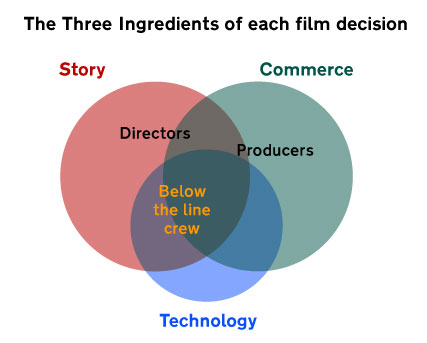
One of the things I used to look forward to be about being an editor was knowing the art of being an ambassador. You start as a translator, but as you get to know the other worlds with which you must interact, experience makes you an ambassador. I had this romantic notion that the editor sits mid-way between the worlds of ‘Story’ and ‘Commerce’ in the land of ‘Technology.’

Sometimes the ways of Commerce need to be explained to the world of Story. Sometimes the truth about Technology needs to be understood by Commerce. I thought that the editor should be prepared to think like the director when debating with the producer and vice versa. I now see that there’s no time for this sort of debate. The editor is there to implement the director’s vision using technology in order for the producer to reach the audience they want.

Editors need to understand the way directors see the film, producers see the film and what is possible to implement with the given technology.

I’m still interested in the combination of story, commerce and technology. I suppose all descisions made on a film will be influenced by at least one of these ingredients…