Given the nature of modern production techniques I wonder if the job or second assistant camera and apprentice editor might be combined in the near future. Any problems with digital files need top be caught at any stage in the process.

This could be the job – loading the solid-state memory onto the camera, where once the camera would need unexposed negative in 1000 ft reels. Once the memory is used up, the loader needs to load it into a computer or separate storage device and load a backup onto a different device. Once these copies are demonstrably OK, the storage device is erased in preparation for loading onto the camera again. Then the loader could go to the editing system and load the footage onto the computer.

The reason why it could be a good idea to use the same person, would be to safeguard the information associated with each take. The setup number, take, camera number, frame rate, scene name and timecode can be incorporated into each digital file from capture to final grading.

Due to scheduling and budget considerations, there are no apprentice editors and few second assistant camera people on many productions. It’s up to the editing and camera team to work together as if they were combined into one person. Especially as it is the job of the assisting team to create the environment for the editor to edit, to make artistic decisions – to make sure they need not know the ins and outs of the newest software upgrades and bugfixes from Apple, Avid, Adobe, Panasonic and Red.

1993:
I Love Typography – A reminder of the kind of stuff I used to read at the St. Bride Printing Library in the early 90s.

The Elements of Typographic Style Applied to the Web – Schizophrenia resulted from me being a SGML purist in the early days of the web while designing magazines. One part of me believed that control over how different web tags are displayed should to be left to the reader in Mosaic and Navigator. The other spent time coming up with the perfect distribution of spacing in fully justified 9 on 12.5 Goudy Old Style on a 48mm measure. Maybe it’s time I bought the CSS upgrade to my WordPress blog.

2009:
Boxee – An open-source media browser than combines video and audio on your computer or AppleTV, content served from the web and the interests of your social network together in one application.

teehan+lax – twenty years ago, I liked the idea of being a user interface designer. Maybe I might have made it to a place like this, and be blogging for them too.

friendfeed – Matt Davis asked me if there was a social media aggregator for Twitter, blogs, comments and other services. He wants a way to keep up with the various online activities of friends and interesting people. My feed combines my Twitter posts, Vimeo uploads and video choices, blog posts and comments on other sites onto a single page. This seems to work for me at the moment.

Most people would never know it, but for the last few hours there’s been a big debate on the future of Twitter’s search function. Not a big deal, but it strikes at the heart of how different people use same social media platforms in different ways.

The story starts with a blog post by Loïc Le Meur: ‘Twitter: We Need Search By Authority’

We need filtering and search by authority. We’re not equal on Twitter, as we’re not equal on blogs and on the web. I am not saying someone who has more followers than yourself matters more, but what he says has a tendency to spread much faster. Comments about your brand or yourself coming from @techcrunch with 36000 followers are not equal than someone with 100 followers.

This is followed by some people you may not have heard of with the following…

Bob Warfield:

This is a seriously good way to make Twitter search Fail big time. No better way to amplify the Echo Chamber. Is that all Twitter is? The Follower haves talking while the Follower have-nots listen? Have nots are to be seen and not heard? “Let’s move the riff raff aside, this is our conversation,” seems to be the message.

Robert Scobie:

Bob Warfield has it all right: Loic Le Meur’s call for authority-based Twitter searches is all wrong.
What is Loic’s idea? To let you do Twitter searches with results ranked according to number of followers.
You’d think I’d be all over that idea, right? After all I have a lot more followers than Loic or Arrington has.
But you’d be wrong. Ranking by # of followers is a stupid idea. Dave Winer agrees. Mike Arrington, on the other hand, plays the wrong side of the field by backing Loic’s dumb idea.

Michael Arrington:

For the record, I agree with Loic. Being able to filter search results, if you choose, by the number of followers a user has makes sense. Without it, you have no way of knowing which voices are louder and making a bigger impact. It’s a way to make sense of a query when thousands or tens of thousands of results are returned.

It looks like some of those that care about the future of Twitter think that this idea will relegate Twitter to an online version of The National Enquirer (or the Weekly World News).

Different Twitters for different folks

For some Twitter is a network for sharing status: ‘I’m off to the pub for a while,’ ‘Great weather up here in Hertfordshire!’ Others use it for personal branding or PR: ‘Why does interactive TV assume a single viewer? Why not prepare for a remote per person?’ – @alex4d, ‘My Interview of the Year: http://tinyurl.com/7wac9q Thanks @timoreilly!’ – @Scobleizer. Those are two of the reasons for wanting people to follow you – to keep them updated on what’s going on in their lives, or to influence/inspire/impress a wider network.

Also Twitter is used by people to follow others for different reasons at different points in their day, depending on mood and status (‘Just mooching around on the computer to fill time’ – ‘Researching the use of social media platforms in theatre’)

The fact something as simple as putting your thoughts online can be used in many different ways has made Twitter very popular. As the number of users rises these conflicting uses might cause problems. That is why there is this kind of debate about something as simple as search – it might restrict or direct Twitter’s use in directions that some don’t want it to go in.

A Twitterer with fewer followers weighs in with a point

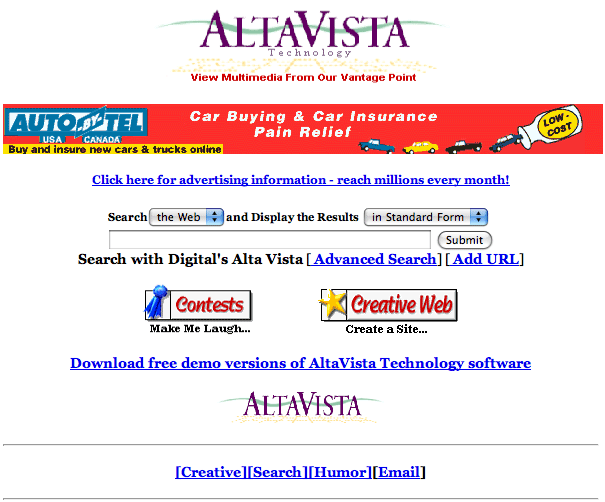
Twitter search is almost at the stage internet search was when Digital introduced AltaVista:

altavista1996

AltaVista became the main page used for search because its host computers could index the internet more quickly than anyone else. It was the most up to date search. The order in which results were delivered was based on the frequency of the word searched for on a page.

Eventually Google came along and worked out a method for producing the right result quickly. Their page-rank algorithm used various statistics to calculate the ‘authority’ of the organisation that created the page on which the search text is found. As the years have gone by the art of SEO, Search Engine Optimisation, has been about site designers using web content to establish the authority of the websites they manage.

I suggest that Twitter’s search function, or even home feed filtering system could use a similar system: show me Twitterers with ‘authority’ – but this authority need not only depend on number of followers, because who knows why those people follow that person. The number of people followed could be important. What about the number of direct messages, or messages responded to, or retweets, or number of links posted that no-one else has posted, but turn out to be very popular? You could also take frequency of posting into account, the amount of dialogue tweets bouncing between two people, or even the frequency of updates to the page linked to on their profile.

Some see the battle between the search engines and the SEO community as an endless arms race, where Google and others use ‘security by obscurity’ to hide the methods they use to rank search results. This battle may move to Twitter search (once Twitter starts mattering). However, a new front could be avoided if Twitter searchers could ‘roll their own’ Twitterrank algorithms.

Do you want to follow me?

What are the considerations you have when deciding to follow someone who has followed you? These are the considerations you might want to be included in your Twitterrank method: I look at the subject and frequency of recent tweets and combine that with having a look at the page they link to in their profile. Is it updated regularly with content that I’m interested in. In consider my twitter feed as a series of thoughts – some of which coalesce into ideas expressed on my blog. If a follower seems to be using Twitter and their site in the same way as me, I’m more likely to follow them. Sometimes would be useful to me for Twitter to be able rank search results or filter the main feed using these criteria. However, depending on how I happen to be using Twitter, I might want to use different search or filter ranking techniques.

If other people could get useful results with a specific Twitterrank algorithm of mine, it would be useful if they could use it too. They could take a copy as it is, or possibly subscribe to it if I feel the ranking method needs to be updated.

I guess Google defines a successful search rank when a user doesn’t click on the second page of results. Searching and filtering in Twitter is a little more complex: it depends on why the person is searching and filtering. Are they removing the clutter of thousands of tweets, or are they refining their feed to focus on a specific debate? Only by trying different ranking systems will we define which models are useful. We could then have different system for different people. That would make life more interesting for the ‘Twitter Search Optimisation’ community

A single method handed down from on high seems very Google and old-fashioned. I think a roll-your-own twitterrank system seems much more ‘2009.’ What do you think?

On the BBC iPlayer, as well as watching TV from recent days or weeks, you can also listen the output of national and local radio stations. Most music shows can only be heard for seven days. The podcast versions cannot include any commercial music. For example, I can listen to the Adam and Joe show on BBC 6 Music in full (three hours long, in a format relatively difficult for people to keep on their computers) or the podcast highlights on iTunes (mp3).

Imagine if audio (and video) broadcasts and podcasts were combinations of the broadcasters’ and local playlists. If music cannot be licensed for more than seven days, the podcast playing application could insert music from the playlists on the listener’s device. If tags were added at times when music is played stating the title and artist, it could play from the local device if present. If not, similar music could play. In Apple’s iTunes 8, the Genius system is designed to create playlists of similar music. That system could find replacements in a listener’s library to follow the mood of the show.

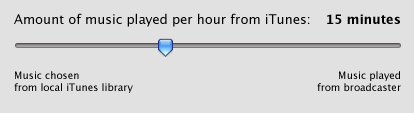
If you were listening to a combination radio broadcast/local playlist ‘live,’ there could be user-interface item to how much music content was from the radio station playlist, and how much is local:

music-choice-prefs

This could be the way that future radio stations work, each listener could configure the shows they way they want. They could choose how much control they have over the music, whether they hear news, weather or traffic reports. Different shows might have different settings depending on the music choice or the kind of things the DJs say between the tracks.

Listen to the most recent Adam and Joe radio show using this RealPlayer location. Listen to the highlights podcast via iTunes.

It would be interesting to imagine a similar system for visual content.

What if my visual feed was similar to my audio feed – the way music is played on radio. What if media organisations had playlists that I subscribed to?

Maybe the visual channel that I will tune into will be made up of four to five minute vignettes. Longer than traditional previews, they’d be excerpts from dramas, comedy shows and documentaries. Entertaining and stimulating on their own, but with the option for me to wait for the next ‘track’ to come along, or for me to choose to see the rest of the play, film, documentary, documentary series or comedy show. Like singles on a radio station, I would expect high- medium- and low-rotation pieces. They could be designed to be re-watched.

Movies, TV shows and documentaries usually include ‘set-pieces.’ These are the bits that you talk about afterwards without reference to the plot. The sections excerpted in the better review shows: ‘Remember the bit when they were trapped in the trash compactor and the monster with the one eye attacked them?!’ ‘What about that bit when he had to stab her in the heart with the adrenaline needle! Wow’ ‘I didn’t cry when she told that story about how her owner forgot about her when she grew up and left her to be sold by the side of the road… it just got a little dusty in the room!’ These are the set-pieces that could be included in a visual station feed. Each could have simple intro to explain the stakes for those who hadn’t seen the source film or show. If you register that you have seen the source, the big moments from the second half could also be included in the playlist.

It may be that not everyone will want to pay the full £6 for the 2 hour film, or £18 for the complete 24 part series. They might want to pay a little less for a set piece or two. Just as people today pick the best tracks from an album as opposed to the whole work.

Imagine if short films and animations could get included in the mix. What would a TV channel be then – a filter to prevent you being taken over by the massive flow of content out there? What about shared experience?

We’ll see.

Some radio stations are different from others. They can be divided into two groups: entertaining and stimulating. On the entertaining stations, the vast majority of the tracks I hear, I like. On the stimulating stations, things are less certain. DJs who care about music more than the musicians. People who are still DJs (instead of the industry term: ‘presenters’), who know who they are is less important than the music they choose to play.

I’m not always in the mood for the stimulating choice. Sometimes I even want to have music on that I can ignore at some level. But sometimes I want to hear stuff that I might not like. Then there is a better chance that I will hear something else – one track later – that I would never have heard before. If I followed my demographic and listened to a radio station that played music from my youth, I’d find that entertaining. Just not very stimulating.

That’s radio. How does that translate to the visual medium…? To go in another direction: how can I integrate my media with that broadcast from elsewhere?

I thought it would be months until I had a couple of high-class dilemmas like the two I have at the moment. They’re no big deal, but for an (as yet) unprofessional writer such as I, I’m surprised that they’re already here.

The first one is simple. As I’ve managed to get a good number of links to my Final Cut plugins and tips, I got attention from a company that sells plugins. It might be that yesterday’s post was prompted by that. A nice man from Noise Industries sent me an unlock code for their FxFactory plugins.

I probably wouldn’t have written yesterday’s post if he hadn’t. I would have written it eventually, but having access to the full version of FxFactory made it easier. I know this because I downloaded the trial version back in September. I didn’t write about Quartz programming then. I liked the system but didn’t plan to teach myself Quartz visual programming at that time, and didn’t know I would be creating Final Cut plugins. I can be forgiven for writing about something interesting I’ve recently discovered more about I suppose.

The catch was I missed something out of yesterday’s post: that there is another plugin system that gives Final Cut users access to Quartz composition, that created by CHV Electronics. This wasn’t an oversight, I mentioned it while writing and thought that it would be a sign of ‘ingratitude’ to Noise Industries if I mentioned it. Looking back I’m sure they wouldn’t mind, as competition and comparison in software is a good thing.

That was a mistake. I realised this morning that I had let a free gift influence my writing. Normal among some writers, but probably not for me. This is coming across as po-faced, but I find it an interesting part of my part in social networks.

vimeo-dilemma

The other dilemma is slightly different: I’ve been complaining in Vimeo’s forums for the last few months that it is ridiculous that they haven’t yet opened up their pro service (known as Plus) to international users. I was planning to write a detailed article when Vimeo gifted me Plus membership without me asking. That took the wind out of my sails, but it shouldn’t stop me from writing what I want. It is very unlikely that Vimeo is worried about what I write, and wanted to give me something to make up for a long delay, but it is odd that I now have to take this into account.

So if dilemmas are the sign of success, I’m looking forward to learning from the next one!

Given that Final Cut’s scripting language has been around for many years now, it is obvious that it is too complex for editors, and not advanced enough for graphics programmers. There have been a reasonable number of FxScript plugins, but not very many if you consider how many copies of Final Cut are out there.

A few months ago I decided to check out FxFactory, the plugin system from Noise Industries. It gives non code-writers the chance to create their own plugins. Instead of learning Apple’s version of the C programming language and their development environment, people can use Quartz Composer to program their plugins. Quartz Composer is a free application you can install from your OS X DVD. It is used to create user interfaces for applications for Macs and iPhones, screen savers and interactive animations within applications. The effects in Photo Booth are implemented using Quartz compositions. Some VJ software uses them for music visualization.

quartz-composer-ui

FxFactory lets you use these animations as filters, generators or transitions in Final Cut Pro, Motion and Adobe After Effects. They also provide some useful bits of code to use within Quartz Composer to create plugins.

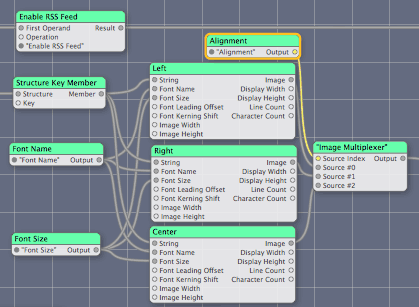
The important thing to understand about this system is that although Noise say that you don’t need to write a line of code to create first class plugins, you’ll still have to learn a kind of programming. You create Quartz compositions in Quartz Composer by adding patches to a layout and linking the outputs of one to the inputs of another.

qc-code

This is a small part of a Quartz Composition that takes an RSS feed and animates the headlines appearing in front of a rotating globe. Here you’ll see an ‘input splitter’ patch selected. This takes the input from a control from the Final Cut filters tab and sends it to other patches. As the control is a pop-up menu for choosing whether the headlines are left, right or center aligned, the input splitter patch sends a 0, 1 or 2 to an ‘image multiplexer’ patch. This kind of patch uses the number on its ‘Source Index’ input to choose which source image to send to its output. Each of the images sent to ‘Source #0’ ‘#1’ and ‘#2’ is generated by an ‘Image with String’ patch, a kind of patch that takes some text (a ‘string’ in programming parlance), some font specs and outputs an image. Each of these patches are named to show what alignment the text they produce will be: left, right or center aligned. As you’d want the text to use the same font and size whichever alignment you choose, the inputs come from the output of splitter patches for font name and font size. The inputs from the controls in the Final Cut filter tab come from these two patches and are split so that they are sent two all three alignment ‘image with string’ patches.

It may not be code writing, but it is still programming. As necessity is the mother of invention, you might discover that needing to produce a specific result is a great incentive for learning how to make it happen.

To see what others have done with Quartz compositions in Final Cut and elsewhere, check out Noise Industries, Futurismo Zugakousaku and Quartz Compositions.

You’ll need to download any .qtz files to watch them in QuickTime player or install them as screensavers to Your Macintosh HD/Library/Screen Savers

Looks like my Closing Credits Pro plugin will be created in Quartz Composer made available to Final Cut, Motion and After Effects users using FxFactory.

If you design enough books on a school of therapy that seems to work, you’ll find that the incorporated ideas would be useful for anyone. You don’t need to be a ‘client’ (the current name for patient) of a therapist to learn from the ideas of solution-focused brief therapy or occupational therapy.

One of the great things about occupational therapy is that it doesn’t let the client’s past get in the way of providing useful help.

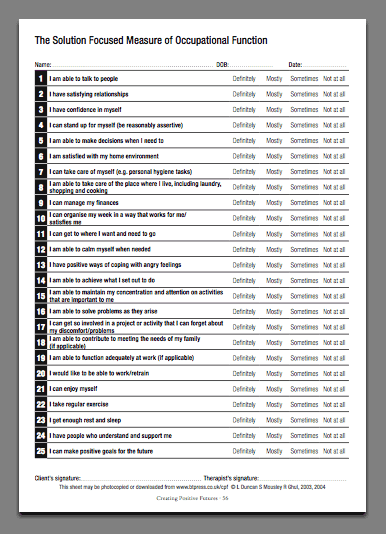
The problem is that it takes a long time for an initial assessment. In a book that I designed, a measure is proposed to aid the conversation between therapist and client. The Solution Focused Measure of Occupational Function. Instead of spending a few days finding out useful things, it takes a single session, going through these questions with the client:

sfmoof

How many questions would you answer with ‘definitely’? Possibly there are some tips here for New Year’s resolutions.

To read the introduction of the book as a PDF, visit its page at the publisher. If you want to learn more about brief therapy, check out the books (with more PDF samples) at BT Press or visit Brief’s website.

From a user interface point of view, the authors specifically designed the possible answers so that there was no middle option – only four answers: definitely, mostly, sometimes, not at all. They found that if clients didn’t want to take a position on a question, they would choose a neutral answer.

When telling tales, whether it be fairy stories to children or explaining how to use complex technology, you should have a good idea of what your audience understands.

When explaining computer technology, I imagine their attitude to understanding how it works is similar to my attitude towards car technology. I don’t want to understand cars, I want them to run reliably without me ever having to see how they work.

The subtle difference when learning computer technology is that terminology is a problem. When we learn about chemistry, we are told about atoms, molecules, acids, covalent bonds and condensates. When the subject is electronics, we have to understand diodes, resistors, capacitors and amplifiers. In most fields of learning, we use new words to understand. In information technology, each term comes from a normal English word: file, directory, click, mouse, disc, bus. Some words come from less everyday words such as interpreter and icon.

I think that because everyday words are used to describe technology, when people come to understand it, they can get confused by the normal use of the word in the world of technology.

14 years ago I was introducing my friend Neil to the Macintosh. I explained the mouse, menus, clicking, icons, windows. He took notes. I then showed him how to move documents from one folder to another, and how to move folders from place to place on the computer hard drive. He then asked me a very pertinent question:

“What is the difference between a file and a folder? They seem like the same thing to me.” I explained the difference in terms of the computer, but that confused him. “So in the Mac, files are different from folders. In real life they are the same.”

He’s right of course. In the real world, we used to take different bits of paper with content on the same subject and put them in a card binder which was called a file. “Could you get me the letter I wrote to Jim at Prudential? It’s in the insurance file in the top drawer of the filing cabinet.” “I’ll just catch up with my filing.”

The term ‘file’ comes from the very early days of computing. It used to be that computers were programmed by operators who set a series of input switches in sequence, following instructions typed on paper. This became a lot simpler when these combinations of switches could be encoded on punched cards. A program was stored on a series of cards which could loaded onto a card reader and read one by one. The term file probably comes from the concept of a queue of instructions, a dictionary definition of file is ‘a line of people or things one behind another.’

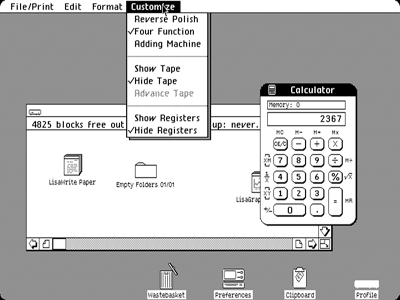
When Apple first popularised WIMP principles (Windows, Icons, Menus, Pointing devices) in user interface design on the Lisa computer in 1983, they had to introduce people to many new ideas. Before Lisa people hadn’t heard of using windows and icons for organisation. Menus usually filled the screen when a program was started – a special keypress took you back to the menu to change modes. Apple decided to call programs applications, came up with a way of going back if you changed your mind (‘Undo’) and referred to computer files in directories as documents in folders.

In those days menus titles were verbs:
lisa_file

You ‘File’d a document, ‘Edit’ed a selection, ‘Format’ted a selection, and ‘Customize’d the application you were running.

A year later, the Macintosh arrived, this convention continued, but the menu title of ‘File/Print’ was abbreviated to ‘File’ as the Mac screen was much narrower at 512 pixels wide, and menu bar space was at a premium.

After a few more years of applications for the Mac, Apple realised that menus in applications were better understood by new users in terms of nouns for menu titles, verbs for menu items. The order of the menus should also give some idea of the structure of the kind of information the application edits. The order from left to right goes from largest to smallest logical unit. The Apple symbol represented commands associated with the Mac. The file menu was where all the commands associated with the current document were. This is where you open, close, save and print documents. The edit menu is for the verbs associated with selections: you cut, copy, paste, find and select all here. The theory went that the next logical unit below that of document would be controlled by the next menu. In desktop publishing applications that would be the Page menu, where you can add, move, format or delete pages. Then you’d have a Text menu or Picture menu etc.

This means that if Apple had the courage, and that enough of their computers had wide enough screens, they would have named the menus ‘Document’ and ‘Selection’ instead of File and Edit. They later added the application between the Apple menu and the File menu, but they gave it the name of the currently running application.

All this goes to say, remember what your audience knows before you tell them a story. For anyone over 45 bear in mind that they might have a very different understanding of the technical concepts you think are generally understood. This difference is down to the fact that they haven’t yet come across someone who knows the way they see things work. If you don’t have an idea of what they know, don’t be surprised when what they hear and what they understand is very different from what you intended.