Archive

Alex

I went to see “Lust, Caution” this evening. The film was great. Most of the film was in close-ups, but there were also some stunning wartime cityscapes.

The fact that big-budget movies can now recreate any city in any time-period cheers me up. In twenty years, there’ll be a simple piece of software that will be able to render any background onto any shot taken by a camera – moving as well as still. The world of 3D simulation for use in the home will start with flying over mountains in the Arctic or amongst the animals of the savannah. Eventually we’ll be able to take a walk down any street in any city in the world in any time period we choose.

City plans and photos and artists impressions and reportage will be combined to create these simulations. Brands in shops will be determined by contemporaneous photos cross-referenced by corporate archives. Streets will be populated by simulations of people based on photos taken at that time. Newspaper archives will be processed and combined with other databases into huge 4D models.

I’m looking forward to walking down my street in London on the day that I was born. Where and when will you walk?

I may have a camera that can shoot HD, software and a computer that can edit HD, but my SD TV and LD iPod and iTunes is good enough for me.

In an article over at Roughly Drafted, Daniel Eran Dilger argues that Low Definition content will be wildly more popular than HD. LD is what people watch on iPods, what they convert their DVDs to, what whiles away their time on YouTube (and YouPorn).

HD appeals to less people here in the UK. In the US, SD is associated with broadcast TV at a ratio of 4:3. In the UK over 90% of SD broadcast is at 16:9 – widescreen. That means that the vast majority of TVs in the UK are widescreen TVs. The PAL TV standard also has a higher visual resolution (with a lower temporal resolution to make up the difference) than NTSC. It follows that most consumers will not see much difference between a vertical resolution of 525 lines (the 51 remaining lines are used for other stuff) and 720.

Of course as people replace their TVs, they’ll get TVs with chips that can interpret any HD signal. They’ll be scaled onto LCDs and Plasmas of many different resolutions. 95% of the audience won’t see the difference. They certainly won’t see the need to pay extra for HD content when SD is good enough.

720 by 405 24 times a second is enough for almost everyone. The rest aren’t enough to support one HD on shiny discs.

I used to spend a lot of time watching TV. There were certain shows I couldn’t miss. I had to get home in time to see them. Then I picked up a little motto from a song by The Lemonheads called ‘The Outdoor Type’:

“I can’t go away with you on a rock-climbing weekend;
what if something’s on TV and it’s never shown again?
It’s just as well I’m not invited; I’m afraid of heights.
I lied about being the outdoor type…”

I realised that everything will be available one day, so why bother catching it the first time it is on. Before iTunes and DRM, I thought that there were going to be so many channels that all TV will need to be repeated many times to fill up all those schedules. Now I can see that all TV will be available to me online.

My VHS player broke four or five years ago, and I never got around to fixing it. I learned do without timeshifting and archiving films and TV shows. I recently got a hard-disc-based digital recorder. I can pause TV, record two channels at once, record whole series of favourite shows.

Now it is a lot easier to be polite. When my flatmate wants to catch up or have a meal with me, she doesn’t want our conversation interrupted by the TV. Now that I don’t need to miss anything, I can stop watching TV and chat for as long as I want. My old priorities weren’t right, this new box has made it a lot easier to do the right thing.

There follows a footnote from a book published and printed 187 years ago. I found it in my parents’ library.

Queen Caroline’s trial - book title page

Title: The Legislatorial Trial of Her Majesty Caroline Amelia Elizabeth, Queen of England, Consort of George the Fourth, for the Alleged Crime of Adultery with Bartolomeo Bergami.
Printed and published by H. Rowe, 1820.

A footnote on the fandango

The Solicitor General: Do you remember a person of the name Majoretto or Mahomet, being in the service of the Princess?
Theodore Majocchi: Yes
SG: What countryman was he?
TM: He was from Jaffa
SG: Did he come on board the Princess’s vessel at Jaffa?
TM: Yes
[…]
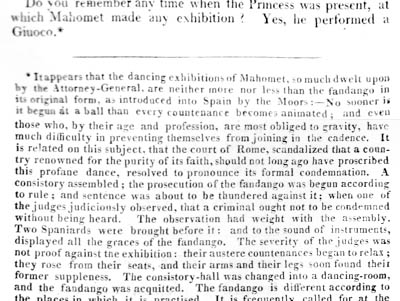
SG: Do you remember at any time when the Princess was present, at which Mahomet made any exhibition?
TM: Yes, he performed a Giuoco*

*It appears that the dancing exhibitions of Mahomet, so much dwelt upon by the Attorney-General, are neither more nor less than the fandango in its original form, as introduced into Spain by the Moors:- so sooner is it begun at a ball than every countenance becomes animated; and even those who, by their age and profession, are most obliged to gravity, have much difficulty in preventing themselves from joining in the cadence.
It is related on this subject, that the court of Rome, scandalized that a country renowned for the purity of its faith, should not long ago have proscribed this profane dance, resolved to pronounce its formal condemnation. A consistory assembled; the prosecution of the fandango was begun according to rule; and sentence was about to be thundered against it; when one of the judges judiciously observed, that a criminal ought not to be condemned without being heard.
The observation had weight with the assembly. Two Spaniards were brought before it: and to the sound of instruments, displayed all the graces of the fandango.
The severity of the judges was not proof against the exhibition: their austere countenances began to relax; they rose from their seats, and their arms and legs soon found their former suppleness. The consistory-hall was changed into a dancing room, and the fandango was acquitted.

As I passed a local shop yesterday morning, I saw that it had been gutted. I was away in France last week, so I didn’t notice that the shop had closed down.

A local shop -2007

I have lived on the same block on and off for over thirty years. The launderette had been there all that time. Suddenly it’s gone. When I was living at home with my parents, we never had a washing machine. We had to go to our local launderette. I have many memories of that shop. A neighbour gave me a washing machine a few years ago. Since then I visited the launderette much less often. I’m sad that it has gone. We mourn the things that pass – they remind us of our own impermanence. The alternative is to celebrate change – at all scales of experience.

This sudden change in my environment reminds me that I should treasure the everyday. The nearby shops. The street where I live. I know the most valuable pictures and videos I have taken over the years have been the ones that capture elements of my day to day life. It is not difficult to remember the special events, the occasions and world travels. The slow evolution of the rest of our lives deserves to be captured.

I suggest you do something soon to capture the quotidian.

As part of the review of every decision made by the Labour Government under Tony Blair, it seems as if Gordon Brown is trying to find a way of forgetting all about introducing mandatory ID cards for UK citizens.

As well as the privacy issues, the main stumbling block is the cost per card. The estimates start at £80 per card and higher. That’s the cost of the card with the technical and administration overhead. The card would replace the driving licence and passport, but people forget how much they cost. They might see the fee as another tax.

A solution – if you want one… – is to get the media companies to pay for it. They want the public to have a way of proving who they are so that their media will only play for those who have paid for a license. If the BBC’s content only plays for those with UK ID cards, people will be able to distribute the files as much as they want.

For an ID card to be acceptable in the UK, there has got to be a big benefit for citizens. I would say that having access to all the media you have the rights to see and hear at any time in any place would be a big benefit. For example if I had bought the right to watch any moment from Friends without seeing any advertising on screens up to 42″ in size, I could be with friends anywhere and simply prove who I am. The media should then be streamed to the nearest flat surface for our entertainment.

Maybe an ID is worth that convenience, so much so that people from other countries might want to buy in to the UK…

For those of you visiting from the BBC iPM blog, here is a very large version of my suggested design for the London tube map. This is a version that illustrates the system as it could be in 2012. That means a more extensive London Overground network, some DLR changes and the completion of the station changes around Shepherds Bush.

London’s underground and overground network
Click to enlarge (a lot)

For more on the design, see my page on the design of London’s tube map.

…to end my short diversion into the world of public transport, one more idea.

People who use public transport rarely usually choose a train before a bus. Train maps and services are simpler to understand. They get into much deeper trouble when a line is disrupted. What are the alternative routes?

How about setting up a bus route to follow each tube line and inner suburban train line. They would have stops at major stations, and if the gap between stations is large, they’d have a stop mid-way. These routes have already been defined by the train companies: they have planned them for the case where they need to provide a replacement bus service when the line needs to be closed.

This means you can have a 24 hour service on all train lines – using buses. It is a lot easier to translate your understanding from a tube map to a set of buses that follow the same routes.

…now back to the movies…