the-shape-of-screenplays

This is the way we’ve told stories for thousands of years.

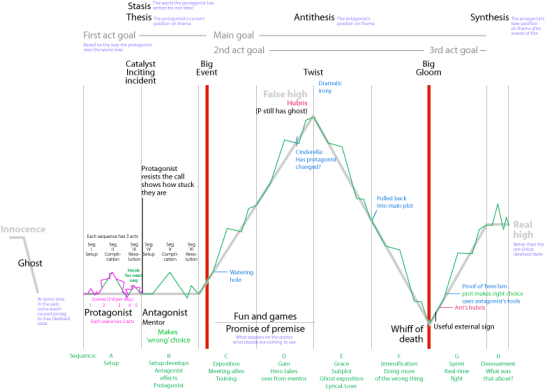
Here is a PDF based on the ideas presented by The London Script Consultancy, the people that organise the screenwriters group that I go to in London. It shows a line that represents how well the protagonist is doing. It starts with the line lower on the page. As the adventure starts, the protagonist does well – the line rises up the page. At the mid-point, the line falls down the page so that the protagonist is even worse off by the end of act 2. Luckily, due to the lessons learnt during the course of the story, the protagonist does well in act 3 and ends up in a better state than at the start.

I hope this will make a lot more sense when you download the PDF.

Another point is that each of the eight sequences  also has the same structure within it, as does each scene. This is known as a fractal structure (the same pattern at different scales), but if you don’t want to bother with chaos theory, please don’t worry about fractals.

…you might want to see this one!

Donna took me along to Paula’s place near the Lincoln Centre to see a rough cut of ‘La Americana.’

This is the docmentary to see if you want to explore the dilemma millions of people all over the world face: Choosing between being with those you love and supporting those you love.

What would you do if you had to go hundreds or thousands of miles to earn money to support your family. Some people don’t see their families for months on end. For illegal immigrants, months can stretch out into years. Imagine leaving your daughter at home and taking the huge risk of attempting to enter the USA illegally in order to earn money that can’t be found in your native Bolivia. What if you left your daughter when she was six, and she was about to turn 15. Imagine how much of her life you’ve missed out on. What if by returning home you cannot support your family any more?

That’s the story of ‘La Americana’ – by Nick Bruckman, Jesse Thomas and John Mattiuzzi.

The film looked very professional: the ‘rough sound mix’ was perfectly fine, with lots of good music; the picture quality was great; the scenes were edited very well and flowed into each other very well. All there is to do is to sort out the structure a little: to concentrate on the primary story to be told.

The reason I’ve venturing an opinion is because the team from People’s Televison, the production company, came up with a detailed questionnaire for the audience that I enjoyed filling in. Of course they basked in the compliments, but the also invited detailed feedback on sections of the film that could do with some improvement.

Most of my ideas were about structure – which came from my understanding of screenplays. I hope my feedback was useful.

Another day, another invite to a New York film community happening!

Firstly Donna’s plan: I showed Donna, Jean, Richard and Mr. Power some of my work at the gallery opening on Friday night. Having seen that Donna thinks I might be able to contribute to a pitch for a campaign for the Japanese National Tourism Organisation. A campaign to get more Japanese Americans to visit Japan. This campaign will also work for others to want to visit Japan. We’re going to meet up tomorrow evening.

Donna’s also been mentoring a documentary maker who’s made a film about Bolivia. At 7, we’re off to a private screening.

More as I have it!

A good aspect of the advanced six week course at Manhattan Edit Workshop is the practicality: our weekend homework is to come up with a good deal memo for editors. Instead of first looking on the net, I went to the local B&N. I found some interesting clauses from some interesting books. I’ll post my final version very soon.

I also looked at some other books in the film section. One of which caught my eye.

As I can control the rights to Quentin Crisp’s literary works, I was interested in book called How to adapt anything into a screenplay. The book was OK, but didn’t lend itself to helping me with my project, but there were some good outlining tips. Here are some I though were worth taking note of:

A. What single word encapsulates the theme?

B. What is your pitch sentence: “What if… And then…”

C. Answer these seven big questions

1. Who is the main character?
2. What do they think they want? What do they in fact need?
3. Who/what keeps them from getting what they want?
4. How do they succeed in an interesting/unusual/original way?
5. What are you trying to say be ending the story in this way?
6. How will you tell the story (voiceover/flashbacks/unifiying filmic devices: colour, symbols)
7. How do characters change over the course of the story?

If you can’t answer all these questions, please don’t start writing your script!

Of course there are at least two. The ones north of Washington Heights used to be a single district settled by people from Poland. One side of Broadway features teeming hordes of Hispanic Americans. Ther other is the district that is ‘coming up.’ There are still some places that are affordable for the young creative people coming to make their way in New York.

This evening’s destination was the opening evening for an exhibition at the 207 Gallery. The very reasonably priced pieces are each inspired by New York’s subway system. The most memorable is a huge ball of twine coloured the same as the colour of the A train – the longest route in the system. It is over 31 miles long. The artist discovered exactly how long the route is in miles, feet and inches and made sure that twine making up the ball was exactly the same length.

The magical thing about the evening was the people I met, the people that Jean introduced to me: Tyrel the film maker and artist, Richard the photographer and Donna Tsufura the film maker.

This morning was about an introduction to post-production workflow. That turned into a debate on how much to charge, how long to estimate a job could take, and the relevance of understanding the technology of post.

For a 90 minute low-budget feature where the editing starts after principal photography, the first two weeks are about getting to a first cut. The rest of the time is a debate with the director about how to make each successive cut better. Shot selection won’t change. Most performance selections will happen in the first couple of versions. The rest of the debate is about story strcuture and reordering scenes and reducing running time.

The last re-write! How many editing courses feature screenwriting structure…?

Going back to technology, we explored how to customise the FCP user interface, something I’ve done with browser columns and window layouts, but not keyboard layouts and button bars.

The good thing about invoking the button list is that you can find many commands that you haven’t stumbled over before. You can play just the current marker (from the marker before the play head to the marker after the play head – Control-option-6) or play until the next marker (Control-option-1). I could re-assign the commands, but for now it might be more useful to add them as buttons to my Timeline window (they also work in the Viewer and Canvas windows as well). You can use these commands to see what a subclip of a marker might be like, or to simulate what a visit to a marker delineated section of a video on a DVD might look like.

I also discovered that you can momentarily see specific frames if you hold down control and tap the up arrow (the last frame of the clip before the current one) or the down arrow (the first frame of the clip following the current one). If you add shift, you go one clip further in each direction.

So, my tip is to open the Button List (option-J) and explore some of the commands you find there.

This morning was about documentary. To inspire us in our task of editing eleven minutes of verité footage down to a sixty second vignette, we were shown a bit of ‘American Dream’ by Barbara Kopple. It is the tale of a meatpacking plant’s attempt to save money by laying off workers and hiring others at reduced rates. It’s workers against the long-term unemployed in a small Minnesota town. It was edited like a feature – with even shorter scenes and bigger elisions between scenes (they ended scenes as soon as possible, starting the following scenes as late as possible in the action). For the first 90 seconds I was trying to work out how things were shot. After that, I started to care about the people involved and their story.

We also saw some clips from ‘Pumping Iron’ – a film that illustrated the world of body-building in the seventies by manufacturing a rivalry between Lou Ferrigno and Arnold Schwarzenegger. The battle was won long ago: my spell checker knows how to spell ‘Schwarzenegger’ but not ‘Ferrigno.’ The clips showed how each man was shot and edited in wildly different ways so as to increase the contrast between them.

We also watched the beginning of Woody Allen’s ‘Husbands and Wives’ – because it used the visual conventions and structure of documentary techniques. The first 10 minutes looked great. I’m looking foward to checking it out.

Miles couldn’t make it (he’s preparing for his premiere next Thursday), but I did. Here are my unedited notes:

Thursday, June 7, 2007 – 6:00pm – 7:30pm
Movie Magic: Filmmaking Techniques to Develop your Game

Leba Haber Rubinoff (Interactive Film Director) (Moderator)
Sabrina Gordon (Editor, Beyond Beats and Rhymes)
Melissa Ulto (Writer, Actress, Editor, DJ, VJ)
Edwin Decena (Director, Transformations)
Trevor Baldwin (onfumes.com)
Choke No Joke (Director/Producer, I Am Choke No Joke)
Matt Smith (Producer, BET’s Rap City)

What do filmmakers need to know to succeed?
Sabrina Gordon
Know how to tell a story. Learning software is easy. Story is hard. Learn from film. Of all kinds. Don’t bring a bag of tapes to your editor. Be open to your footage leading you into a new direction. Find an editor who is like-minded, knows your demographic.
Melissa Ulto
Editing is very important. Directing is more than collecting assets.
Edwin Decena
The art of orchestrating your resources: audio, video, crew.
Trevor Baldwin
Find the purpose of the film. Tell your story from different points of view. Execution is problem solving.
Choke No Joke
Watch your footage, find your story. Then take your script to your editor. To tell the editor what you want, you have to know what you want. Study what you want to know. If you have no money – work for free.
Matt Smith
Persistence and creativity. Don’t give up.

How to learn
Sabrina Gordon
I worked for free at documentary production companies. Still don’t know names of bits of equipment. Once you are on the job, the film school difference isn’t that great. If you didn’t go, you know you know nothing. A filmmaker might set up a company to make a film. Deal with the fact they might not be great at interpersonal relationships and politics. You can make it seem naive, but don’t be naive! Prepare, then you can explore the subject.
Melissa Ulto
A lot of heartbreak. Your heart will break to some extent with every project. Get ready: it’s a bumpy ride. You have to fight your fight. We bring the truth for those people who can’t. It’s like giving birth! Use the internet to monetize your work. Think bigger. Not just a DVD. The same footage in many different formats. Look to where the future is going.
Edwin Decena
To learn how to make films, make film. Learn about all aspects. Pitching, writing, shooting, post-production. Music videos a good launch pad. Had to focus on simple stories in a specific period of time. Effects and performance can hide mistakes while you learn. Once you have your own style…
Trevor Baldwin
Develop a thick skin. Keep knocking on doors. Too many people need to sign off on saying yes. Make spec commercials. Base them on standard taglines. Got job making real ads. Some ideas ripped off.
Choke No Joke
Modeled and appeared in music videos. Took camera to shoots. Did his own versions of Hype videos. Copied Hi8 onto VHS. Edited tape to tape. Shot at The Tunnel. Dre and Snoop at the tunnel. Produced DVDs. Learned by watching others. NEVER go to the head of your company over your boss!
Matt Smith
Went to film school. Worked at a bank. Started as runner in Hollywood. Being reliable. If you do well with something small, you are trusted with something big. Learn how to work with people. Ask if you don’t know. Be humble.

How do you visualise a film based on someone else’s script. Do you make a shot list? Do you create storyboards?
Edwin Decena
Read, read and re-read your source. You might find a different way to tell it. Base your plans on what you can afford to do. Get the spirit of your story. What is the premise? Absorb the story. Retell it the best way.
Trevor Baldwin
Make sure your producer is being cost-effective. Once place you know might act as six locations in your script. Producers are doing their best, but add your own insights. Have a deep understanding of the premise.
Choke No Joke
Your producer will get your team. He’ll find the people to help you visualise your film. Be clear how you imagine your scenes.

How do you protect your ideas?
Melissa Ulto
The internet counts as ‘first publication’
Trevor Baldwin
Have another idea. Chalk up losses to experience.
Choke No Joke
Make sure they sign your confidentiality agreement

The technology has exceeded our abilities. Movies are behind music in terms of expression. Does technology add to expression?
Melissa Ulto
We’re developing a few .tv domains. New forms of distribution. Video is going to be everywhere. Content is king. Less money than traditional money. You’ll be able to make a modest living. It is democratic. Lots of dollars leaving broadcast
Trevor Baldwin
onfumes.com is for upcoming filmmakers and upcoming artists to get together. People vote for the best monthly.
Choke No Joke
Online can be very lucrative. $1500 to license 60 seconds of old footage. If you shoot good stuff.

Social justice is what I want to make films about. How do I not sell out?
Sabrina Gordon
There’s no money in those films, so difficult to sell out. I’ve turned down jobs that don’t fit my ideals. Can you afford to live your life based on these choices? I did graphic design while working for an investment bank while working as a part time documentary maker. In the US, socially conscious subjects are not supported. Find other sources of income
Edwin Decena
“Concerning matters of style, flow like a river, in matters of principle, stand like an ox”

How can I raise money on a non-mainstream idea?
Melissa Ulto
It’s a business. I need to pay the rent. If you can’t deal with business, get a partner who can. The people who last have built a foundation. Then you can last for years and years
Choke No Joke
Make the choice. Either you maintain your integrity or you don’t. If you don’t want the politics, get the money yourself.

How can we pay a little less for our music?
Melissa Ulto
Splicemusic.com – many sites can be a lot cheaper. Look for licensable music on the web. Commission your own music from up and coming artists
Choke No Joke
Find producers who don’t sample.

Footnote for old-old-school hip-hop fans. Roxanne Shanté was sitting behind me. I gave her and her friends some flyers for the bit of the JVC Jazz festival that’s happening at the Langston Hughes House.

I’ve been very lucky in getting in touch with the New York film community.

My first contact is Miles Maker. He is currently based in New York, but back in 2005, he was in the UK. I edited his first short film back then. He’s done a lot more since. We met up on Sunday at the Entertainment Industry Expo. He introduced me to Jean Prytyskacz who is working on a series of specials on Hip Hop Comedians. She’s invited me to a happening at a gallery in the Inwood area of Manhattan (the latest ‘coming up’ area of New York). There I’ll be meeting more media people.

Miles took me to the soundtrack spotting session at Hughes House for his current short film production. It was inspiring hearing about the artiste’s career and current work. Amazing getting an update on Go-Go music – a genre that deserved to be a much greater movement than it was. I also had an interesting talk with Larry Robinson about new ways of marketing jazz music.

That Sunday night I did a search for “screenwriting new york” on Google. Two seconds later, the first link came up: a meetup of a group on Monday night! The small catch: the meeting was about reviewing a screenplay from a member of the group. I quickly read the first sixty pages on Sunday night, read the following 70 pages after my first day of my course (as well as the course reading homework)!

We all had a great debate about the screenplay and the method used to develop it: Blake Snyder’s 15-beat outlining method. At drinks afterwards, two people asked me to review their screenplays!

Miles and I will also be going to a panel on Thursday evening at the 5th Annual Hip-Hop Odyssey international Film Festival

…what a friendly town!