There I am, at 1:30 in the morning, near the till of the local bodega. A woman that a vaguely recognise asks me a question. As I answer I’m aware that however debonair I am, there’s a limit to how impressive can be. I’m holding a box of microwaveable White Castle burgers. Oh well. I’ve seen many chain restaurants in my explorations around Manhattan and Brooklyn, but not the fabled White Castle. One of the few fast food chains mentioned in at least two film titles. The closest I’ve come to trying their legendary food was in 1991, when Burger King did a limited edition run of ‘burger buddies’ – a mini double-bun containing two little burger patties. No doubt inspired by White Castle. So, within the next few days I’ll be that much closer to the real thing.

Wish me luck!

New Yorkers are so friendly. They ask for directions. They strike up conversations about Graffiti artists. They ask if they saw you earlier on the subway.

Megan heard me talk to Jean earlier on the subway. She gathered that we might be something to do with the New York film community (is ‘scene’ an old-fashioned term?). Of course, as we’re meeting late on a Saturday night in Chelsea, it turns out the she’s a film maker too. I’d be surprised if this sort of thing happened to me in London. After these last few weeks in New York, I almost expect it here.

Maybe Jean will be able to get both Megan and I into the Brooklyn Filmmaker’s Collective meeting on Tuesday. As guests only of course.

Jean and I were on the way back from a successful meeting of the Epiphany film networking group. We all enjoyed watching Terrell Perkins’ artistic short film ‘A Struggle’s Paradise.’ An impressionistic short film that owed a lot to ‘City Lights’ and the music of Mozart and Orff.

One of the other people attending was DJ Uch, who runs a film showcase each month. There’s a chance that he might show my new 1 minute short ‘First Cut’ at his next event on 22nd July.

All that and it’s only two in the morning!
Today Josh gave us an insight to some of the strategies he employed to cut the feature documentary ‘Barbecue is a Noun.’

When the co-directors first went out to make their film, they interviewed many people on the subject of Barbecue – the cuisine from American South. Each interview followed on from the previous one: ‘Let me tell you who you should also talk to…’ That meant that they ended up very many hours of footage of people talking about and demonstrating barbecue cooking. They went to Josh to find out if they had enough for a feature documentary.

After viewing the ‘best 35 hours’ in the directors’ opinion, he thought there was. The trick was to find the characters in the footage. The people that are most interesting to be with are a good place to start. The people most suited to be documentary subjects are those people going through the biggest changes in their life.

It is much more gripping to be following the story of a man who plans to give up a 20-year career with the government to risk it all on the dream of starting a new business selling the best Barbecue food in the US than it is to follow a restaurateur who’s having problems with her suppliers.

This also applies if you like the idea of building a documentary around a person who you think is very interesting. They may have had an interesting life. They may be quirky and original. Concentrating on a story that demonstrates the biggest change they can go through best brings out their personality. The way they are tested will bring out the character that you think will interest your audience.

The big danger with talking about this film meant that most of us left class this afternoon with a hankering for some real Barbecue. Fortunately, it looks as if our final day class meal will be the best barbecue you can get in New York City.

Thanks to the internet, my producer George Blackstone and I were able to submit our film to the Sheffield International Documentary Festival. She started the form in the UK, I added some info and submitted the entrance fee.

Sheffield Doc Fest is the best festival in the world to submit documentaries to. If you have made a documentary since July 2006, it can be entered. If you are able to attend, you’ll meet the whole industry there too.

I almost wrote a book on music videos. We got to the proposal stage, but MTV was only available to a few people in the UK at the time, so the book-buying public didn’t have a way of seeing the videos.

Now of course, many of the videos I would have written about are available for free for you all to have a look at… (edited to show that all but the Bjork one have been taken down from YouTube)

Hey Little Girl by Icehouse

I liked the videos with a little storyline to them. This one is a mini movie with a fractured time structure(!):

Questionnaire by Chaz Jankel

This one isn’t on YouTube, but is worth checking out. It’s the extended version of the song, so the ideas from the normal version are spread out over a longer time, but it’s worth checking out (despite the poor picture quality):

More recent videos that are worth seeing:

Sugar Water by Cibo Matto

Why edit when you can do the whole video in ‘one take’ – that works backwards as well as forwards…

Bachelorette by Bjork

A story within a story about a story…

This week is documentary week at the Manhattan Edit Workshop. The first was a rousing one about the Mississippi called The River. The body of the film followed a drop of water from an icicle on a branch in the mountains down to a raging flood on the plains. The audio was very important with this one. The initial section sounded like radio, but the soundtrack developed into a poetic voiceover with rousing music and sound effects.

The second was “Johnny Cash! The Man, His World, His Music”. It was pretty odd. After a raggedly shot and performed version of Ring of Fire, we follow Mr. Cash through undergrowth and pasture as he shoots a crow, picks the wounded bird up off the ground and attempts to charm it by stroking it’s beak and singing to it.

The task of the day is to start getting to know an hour’s worth of footage shot at Astor Cuts on Astor Place – a legendary Greenwich Village location. We have carte blanche – we can make whatever we want from the footage. Options include a piece edited to music, a piece narrated by words edited from an interview with the manager or a film based around a single haircut. This’ll help us understand how in documentary work, the editor sometimes must take on some (if not all) of the responsibilities of the writer.

The burden of authorship!

This is an part of what Donna and I have been talking about. On Friday I went up to Inwood again to interview Mike Saijo, the curator of the gallery that I visited two weeks earlier with Jean.

It took 30 minutes to shoot – the deadline was the setting sun. 90 minutes to slice up, colour balance, desaturate and upload to YouTube. It’s for a meeting Donna’s having tomorrow afternoon.

Met Miles in Brooklyn – at the very chilled and homely coffee shop named above. As well as three different kinds of iced coffee and freshly-made pastries, there were also a couple of decks on the street outside playing perfect summer music.

We chatted about movies and ideas while he downloaded some music and sound effects for his second ‘full-length’ short film: Man Up. It has just been accepted into the Martha’s Vineyard African American Film Festival.

I worked the rest of the day getting my ‘Additional Editing’ credit for my work on the film. It was about using alternate takes here, sorting out the soundtrack there, loosening out and tightening up. After seven hours of work we ended up with a version that was 6 seconds longer but twice as good (of course I would say that, wouldn’t I…)!

In the coming few days we’ll be working on completing the Miles Maker 2005-2006-2007 DVD. You can see his micro-short ‘Street Sense’ (2005) on my web site. The DVD will also contain ‘Lark and Cher’ (2006), ‘Man Up’ (2007) and a behind the scenes documentary on the making of ‘Man Up.’

You’ll be able to purchase the DVD from Miles Maker soon.

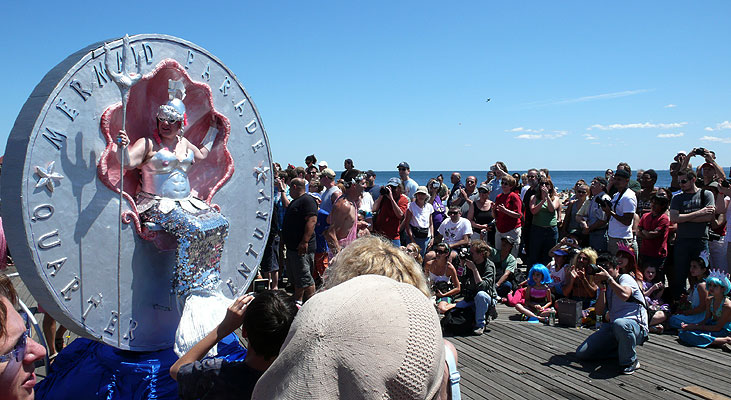
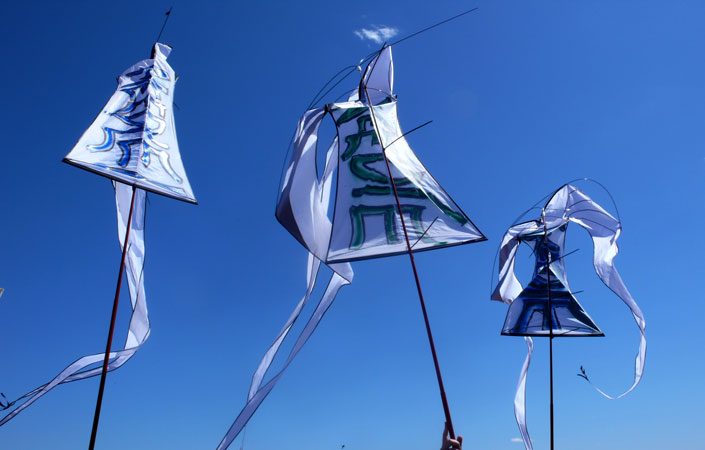
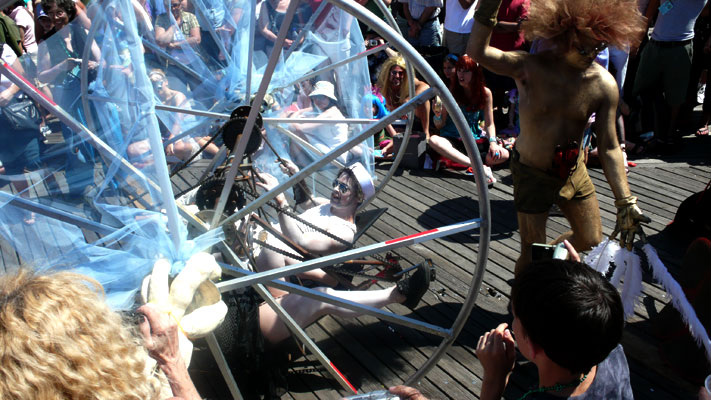
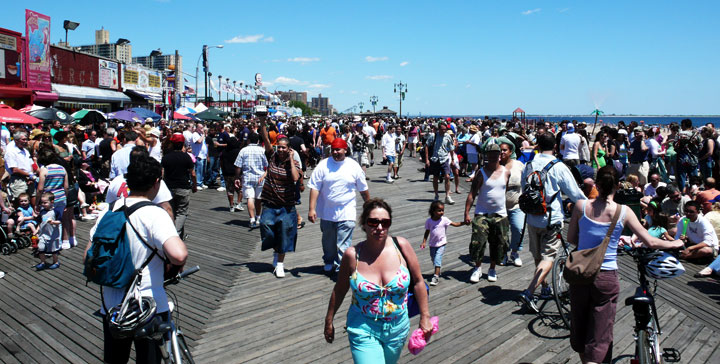
Went to the 25th Annual Coney Island Mermaid Parade. At least I assume it was a parade. Maybe this is what most summer Saturdays are like in most parts of Brooklyn…

Coney Island Broadwalk A Mermaid on a quarterMermaid Parade BannersA pirate on stiltsA recumbant bicycle for two

The parade snaked around Coney Island, along the broadwalk to Surf Avenue. Jean and I picked a very good spot. The marshals were very easy going – we managed to mix in with the parade whenever we wanted to.

“This script needs more reversals in Act Two.”

An easy criticism to make of most scripts, but what does it mean? The word ‘reversal’ is so strong that I used to think that it meant ‘a major change of fortune.’ But when used in writing, it merely means an obstacle for the protagonist of the scene.

If the scene is about your hero wanting to smoke a cigarette, the reversals he faces are a series of increasingly difficult obstacles he faces to achieving his goal. Firstly he doesn’t have any cigarettes, then having got a cigarette his matches are wet, then having got a light from a stranger, having started to smoke he discovers that he isn’t allowed to smoke in the bar where he is sitting, going outside he bumps into the woman of his dreams who thinks he’s given up smoking…

From The Understructure of Writing for Film and Television:

The development of a scene is made up of several reverses leading to the crisis that, climactically, your protagonist must resolve.

Complications (as in ‘complications arise when…’), on the other hand, are crucial turns in the plot:

A complication is a development in the process of events that affects the overall objective of the protagonist…
…A reverse can never be good, while a complication in itself can be neutral: it is how your protagonist handles the complication that is important.

For example, there’s nothing bad about James Bond falling in love, but it adds complications to his mission, and his reaction to falling in love is what matters from that point on in the story.