One of the major differences between the US and the UK at the moment is the day-to-day attitude towards Iraq. In the UK we know that some of the people who volunteered to be part of the armed forces may be sent to Iraq. Every few days we hear that some of our sons and daughters have died over there. In the US it feels as if you are in a country at war. Adverts on TV, at the cinema, elements of the stories we tell each other are constant reminder of the war. For example, there’s an advert on US TV that advises parents to be ready to deal with the conversation they will need to have as a family when a child announces that they want to join up.

I don’t think that kind of involvement will ever come the the UK. But there are signs of wartime appearing elsewhere. This evening I went along to a screening of the finalists in the Documentry category of the Rushes Soho Shorts festival. There 14 finalists. 7 of them were about death! Suzanne was told that was a topic that came up a lot in this year’s entries.

The evening was not as morbid as this sounds. There are plenty of laughs, and you’ll be thinking about and debating these films for a while to come. The documentary session lasts two hours, so check it out at Tuesday 31st July at 10am at Soho Screening Rooms, 2pm at The Montague Pyke, Wednesday 1st August at 10am at Curzon Soho, 4pm at The Hospital and Thursday 2nd August at 10am at Soho Images. Suzanne’s doc is called Out of Time, and is shown approximately 25 minutes into each session.

Will this topic be popular for a while to come, or will we be telling each other stories about something else?
A couple of years ago, my good friend Laura gave me a birthday present. A present she thought might inspire me, but she wasn’t sure. It was Movie Mistakes by Jon Sandys. It is the book version of moviemistakes.com.

I think that this sort of site/book is a back-handed compliment to the art of editing. The kinds of mistake listed here are the ones you can guess: continuity (cigarettes jumping from hand to hand, getting longer and shorter between shots, food vanishing), anachronisms (visible edges of sets, visible crew) and many more.

I think that most contributors to the site and readers of the book think that the film makers managed to make these films without knowing the mistakes they were making, and that they would have fixed them if they knew. I guess that over 90% of the ‘mistakes’ found were well known to the people on set and to the editorial team.

The trick is to know what people are going to notice. There’s no point spending extra time and money fixing things that will only be spotted my the 0.1% of your audience who will be stepping through your film a frame at a time. As long as you know where people will be looking, you can have almost anything elsewhere in the frame – people aren’t going to see it. Also, if the emotion created by the writers, director and actors is compelling enough, the audience will forgive anything.

There are many elements that help make the edit between two shots invisible: consistency of emotion, the story advancing with the next piece of information, the rhythmic timing of the edit (the edit at that point feels ‘right’), knowing that if something vanishes that the eyes of the audience need time to find the next point of interest in the scene, that the composition of the shot on the screen doesn’t cause a jump cut (cutting to a shot that is too similar to the previous one), that people or objects in a scene don’t jump to a different position in the 3D space of the scene (continuity problems).

In In the Blink of An Eye by Walter Murch, he lists these elements in the same order as elements to consider when choosing when to cut and what to cut to. He gives (slightly arbitrary) percentage priorities to each element to show their relative importance: Emotion (51%), Story (23%), Rhythm (10%), Eye trace (7%), shot composition (5%) and 3D continuity (4%).

This shows that the emotions engendered by performance is worth more than all the other elements combined. That means, preserve the emotional line above all else. Neophyte editors take most pleasure in finding elements in each take that let them do continuity matches. According to experienced editors, continuity is the element that will be least noticed by an audience.

Cut for performance, not continuity.

Although film production is mainly about the combined work of specialists, we editors sometimes need do some of the work others are responsible for. We add titles, do simple composites, a little colourisation and temp mixes. This is to make test screenings run more smoothly. It is easier to show audiences ‘good enough’ titles, composites and so on without a lack of such refinements distracting people from the story.

This means we have to create our own temp mixes: add simple sound effects and temp music while balancing the elements to make the dialogue clear.

For a long time I wondered about the pan settings in Final Cut Pro. I found it odd that all the stereo tracks I imported had their pan set to -1. If they were mono, the default pan was 0. That meant that I usually set all stereo tracks to have a pan of 0. I didn’t want all the sound to be on one side of the mix.

It turns out that ‘pan’ for stereo tracks in Final Cut should be labelled ‘spread.’ A value of -1 means that all the information from the left channel in the source gets sent to the left output channel, with the right going to the right. A value of 0 sends both left and right channels equally to both outputs. A value of 1 sends the left content to the right output and the right content to the left output.

This meant that when I ‘fixed’ the pan of my stereo music and room tone effects so that their pan value was 0, I was making sure that the music and room tone sound came from the centre of the stereo field. That’s not a good idea if you want to make your dialogue clear: because for temp mixes, you should always set dialogue to come from the centre (0) with nearly everything else coming from the left and right (-1). That makes your temp mix much clearer.

I think it would be a lot clearer if ‘pan’ was marked as ‘spread’ when a stereo pair is loaded into the viewer. Pity that the value of normal stereo is -1, which is a trap for new users – which is probably too late to change now.

Edward Dmytryk’s 5th Rule of Editing: All scenes should begin, and end, with continuing action

Scenes should not start at the moment the actor starts his first action for the scene. Scenes should not end at the conclusion of the last action of the scene. The audience needs to get the impression that each scene is ‘a fragment of continuing life.’

This is a matter for experienced directors to allow for warm-up actions before the action at the start of a scene, and for editors to recognise these actions so that they know at what point in time to start. The examples Dmytryk gives are an initial walk across a set, sitting down or standing up or hanging up a telephone. Actors can use these actions to ‘get up to speed’ so that the context is set for the scripted content of the scene.

Extra actions at the end of a scene also help editors cut while the actor is in action, so that the audience is left without a complete resolution, a resolution they hope to find in the next scene.

From ‘On Film Editing’ – which is also available in an omnibus edition: ‘On Filmmaking

Just before going to the Cannes Film Festival last year I had an idea for a feature film. It grew out of an idea for a short film.

My father was Quentin Crisp’s agent. He used to be a regular houseguest as I grew up. He didn’t seem odd to me. Children don’t judge adults – they use each person they meet as further information about the different ways adults can be. I thought I could make a little film on this subject. John Hurt’s portrayal in the film of Quentin’s autobiography made both men famous. I realised that John Hurt is now the same age as Quentin was when the film was made. I was tickled by the idea of John reprising the role that made him famous (although he was well-known to some for films that he has already made) in a little short.

A few days after having this idea, I was having a meal with the man who introduced Quentin to my father back in the 1960s. As I was pitching this idea to him, I realised that I could make more than just a short – we could make a sequel to The Naked Civil Servant. Quentin died in 1999. He left the rights of his literary works to my father. That means I can control the rights to any works based on his books. He wrote a sequel to The Naked Civil Servant and other books.

This kind of talk went down well in Cannes, amongst other conversations, and I’ve been thinking how best to adapt his works since then. My father tells me that a screenwriter has got in touch. Brian Fillis is a writer with a pretty good track record – people want to work with him. He’s got Leopard Drama interested making a film about Quentin: An Englishman in New York.

We’ll meet in a couple of weeks, I think as someone who has control over some of the rights required to get a film made, I might be able to negotiate a credit of Co-executive Producer.

At least.

Suzanne’s doc is also in the Portobello film festival – on the day after the one I directed. Out of Time is screening on Monday 6th August at the Inn on the Green at around 8.30pm I think. As for mine, the event is free, so Londoners – go along and give her your ‘support’

For now, download the full brochure (2MB PDF) for the whole festival.

In less than five hours I’ll be getting up to go to JFK and back to London, eager to use my new-found abilities to change my life.

George Blackstone just sent me some good news: our documentary ‘The Things We Do for Love’ has been accepted into the Portobello Film Festival, and will be screened on Sunday 5th August at the Westbourne Studios. The good news is that the screening is free, and is part of a whole day of documentaries – that also includes ‘Love is the Devil’ a drama documentary about Francis Bacon featuring Derek Jacobi and Daniel Craig.

That gives me a deadline to finish my new and improved editor’s demo reel. George can’t be there, so I’ll be there representing both of us.

See you there!

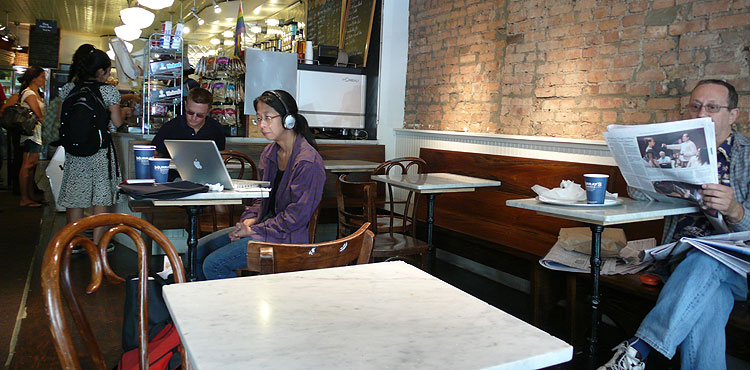
When you see food in films, it always looks better than you can ever find in real life – unless you live in New York. The bagel shops and diners have been all that I’ve hoped for after seeing them in the movies.

That’s bagels

Donna Tsufura reviewing my editor’s demo reel in the local bagel shop. She’s come up with a clever addition that I’ll be working on over the next few days.

The Malibu Diner on 23rd Street

After Jean and I went to see Rescue Dawn, we had indulgent desserts at the Malbu Diner in Chelsea.

Brian De Palma’s editor was the Artist in Residence at The Manhattan Edit Workshop. We’d just watched The Black Dahlia, and we had the opportunity to ask questions.

The film has a lot of voiceover – in the style of the 1940s movies that De Palma wanted to emulate. Bill gave us a couple of tips. Even if you know you are going to have voiceover in a scene, make it work without. It’s important not to introduce the voiceover too early in a scene. Establish location first. Make sure the audience has taken in the scene’s pictures and sound. Then let them see the characters – understand their initial roles in the scene. Make sure that when you do introduce the voiceover that it doesn’t distract from what is on screen. The voiceover overpowers most images and sound from the scene, so be careful.

Start the voiceover at the point the audience becomes curious as to what is going on.

In the Black Dahlia and Assault on Precinct 13, Bill put some fades to black between scenes. We asked him if that was due to act breaks. In some cases it was, in others he said that fades can be used for another reason.

If you do not want the emotion from one scene to be carried into the next, fade to black between scenes.

Bill said that filmmakers know that the effect of one scene on the next might be too strong – it is a good idea to give people time to think on what’s happened, and permission to start a new emotional line in the following scene.

Once editors have worked with directors for a while, they should be able to read the dailies. They can tell how the director planned the scene to be put together. That’s the version you should show the director first – even if you think that there are better ways of doing it. If you omit dialogue, stay in the master when there are many cutaways; start distilling the scene, the director will want to see footage the way they planned in the first place. There might better ways of making it work, but they need to see the way they planned to do it in the first place.

The first version of the film should show all the scenes that the director shot. That is, even if not all the scenes need to be in the film, the director and producer need to see a version of all that was captured. The editor can also create their version in parallel, but the first version to look at will be the ‘script assembly’ version.

After refining the film, fixing scenes, changing the structure, Bill likes to go through each of the scenes again, looking at all the dailies for each scene. It may turn out that once the scene it cut into the film, an alternate reading of a line may work better for the film. This can be seen when the scenes are in context.

That was some of what he talked about that wasn’t specific to the films we saw.