Archive

Ideas

Wouldn’t it be great if you never saw or heard an advert that you weren’t interested in? Imagine those who pay to tell you stories, be they multinationals, governments or the local shop, only talking to you if their message is relevant to you. Combining a register of interests with a deeper understanding of your state at any moment are steps in this direction.

That is why combining a future Google with a future Twitter (or Indenti.ca) will be a powerful combination.

However, once ‘perfect advertising’ is achieved, we might have to get used to a world with less media – unless we are prepared to fund it ourselves.

Here’s how banks work: People lend banks X, banks lend out 3X – knowing that it is unlikely that the people lending them money will want all their money back at once.

Here’s how advertising works: People who sell things want to inform others that those things are available. They pay the media to produce content that an audience wants to consume. While consuming the content, the audience might also take in the salespeople’s messages. Note the word ‘might’ – you have to spend a lot on the off-chance that people will pay attention.

Currently advertisers need to spend 10X to communicate with their audiences, although they would only need to spend X if their messages only were delivered to those they specifically want to communicate with. To paraphrase an old saying: ‘At least 9X of my 10X ad spend is wasted, I just don’t know which 9X.’ TV programmes are too general. Specialist publications can’t deliver the audiences they once did.

Once advertising is perfected, there are three possibilities. The amount of money spent communicating with audiences will stay the same, rise, or fall. This sum influences the amount of media there is in the world. If advertising becomes more efficient and cheaper, there will be less money for people to create TV shows. We may end up with a tenth of the commercial TV we are used to. Alternatively, our availability to advertisers may support more TV, radio and (dynamic) print.

We might be able to decide how much TV we’d like in the world.

It may be that a future tech will create the world of perfect advertising. When that comes along, individuals may be able to discover exactly much any communication strangers want to have with them is worth to the market. They might be able to set their technology to negotiate with the advertisers for admission.

How much will they be prepared to pay for a world of perfect advertising?

[ a post inspired by my trip to tomorrow’s Media Camp London (#MCL2) ]

Last week the BBC reported on a new addition to Google Earth: the ability to explore ancient Rome.

The 3D models and virtual tours of the Rome of 2,000 years ago were created by Past Perfect Productions. I hope they move on to creating more environments for people to explore. Once there is is a market for this, standard ways of modeling and showing the past, things will get very interesting.

It might be that we will be able to explore any place on Earth at any point in history.

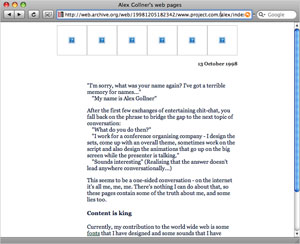
My home page from 10 years ago stored at archive.org

My home page from 10 years ago stored at archive.org

Today Google software continually explores the web and catalogues text and image content for search purposes. The search page lets millions of people all over the world the explore the current representation of the world on the web.

One day similar software will use XML-tagged information to build a model of the Earth at any point in the past. Combining all pictures, words, models, sounds used to represent the past will mean that we’ll be able to search based on the world as it was 2,000 years, 100 years or ten weeks ago.

Imagine looking at the world the day you were born. You could look at your favourite websites filled with the news as it was back then. Once architect and municipal plans are combined in the model with photos taken in the weeks before your birth day, you’ll be able to walk down the street you were born. Or the street where you live today as it was back then.

Witness the model of the world as it was thirty years ago become clearer as governments and organisations release documents kept secret up until now. Once you combine accounts, memos and all the documents kept in world archives, the model will become more accurate.

If you could go to any place and time, where would you go first?

mouth
My new input device

Following up Google’s voice-operated iPhone search application, maybe it’s time we started to think about non-visual interfaces for our technology. We’ve seen them depicted in Star Trek and sci-fi stories for decades. They show heroes of the future engaged in conversations with technology.

I think that children born ten years from now will find our obsession with visual interfaces quaint. UIs are still centered around ‘the document’ – the system used by corporations in the 18th and 19th centuries to organise colonial empires, and by educational institutions to formalise schooling.

It may be that technology will eventually help us come up with a new technique to pass on and store knowledge. Do you conceive of what you know in terms of words and pictures written on documents? That’s not the form I use to maintain my model of the way my world works. Documents (such as this blog) are a transmission method. We may be able to come up with something more effective in the coming decades.

The late 19th and early 20th century and introduced electricity-powered motors to middle-class people’s lives. Clothes are washed and dried using spinning motors. Refrigeration works using heat pumps. The reason why alternating current was chosen as the method for delivering electricity to people’s homes was that motorised devices need AC to work. As the decades went by, electric motors became hidden, less noticeable in everyday use. Technological methods recede into the background as the services they deliver evolve into utilities. Few families have their own electricity generator, water pump and sewage treatment works any more.

In the same way, computers eventually will fade few view, and our connection to the rest of the world will through a voice whispered in our ears and our instructions will be whispered so no-one else can hear. Nearby surfaces will be used as displays for images and video, but probably won’t be the primary method for technology interaction.

There are a few trends that may lead us in this direction.

The idea behind ‘cloud computing’ is partly about getting people and organisations to let go of having a specific place for a document or unit of computing power. We pay for a service that handles making sure that the documents we have are safely backed up and instantly available where we are in the world. The cloud also provides computing power; when an online service starts getting bogged down with consumer requests, it can call on Google’s cloud of computing power to help out for a few hours. We don’t need to know which power station produced the electricity that is keeping out lights on at night, as long as the power is there when we want it, eventually we’ll trust that the cloud holds all the information we’d like to have access to anywhere. It might be easier for us to tell our technology to do what is needed to get us through the day: “Tell this new bank what it needs to know for me to open the new account.”

The natural language interfaces that have been evolving for the last ten years will eventually become that ‘personal digital assistants’ that will spend their time looking after us. For example I Want Sandy currently uses email to communicate, I assume they’re working on a voice-operated version for mobile technology.

Think about how important needing to find or create ‘the right document’ is for us all today. Eventually something will come along to replace this need. Such is the the nature of technology: in the long run it makes every generation feel out of date.

It is time to turn to the educationalists and see if they can come up with something better…

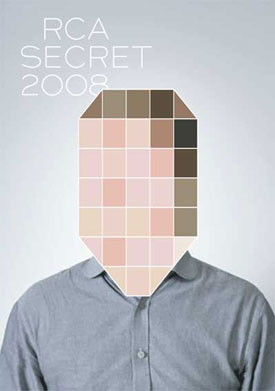
Each year London’s Royal College of Art uses a secret sale to raise money and make a point about fame and the business of art.

From today for a week, Londoners are invited to visit their gallery for the opportunity to view 2,700 pieces of art drawn on postcards. At the end of the week the postcards are made available in a sale where each postcard can be bought for £40.

For the right piece of art, not a huge sum.

rcasecret2008sm

What exactly is ‘the right piece of art?’ Unlike most sales, each artwork is not labelled with who created it. You only discover the artist once you have bought your postcard. The majority of the authors are RCA students, but some are internationally famous established artists and designers such as Yoko Ono, Tracey Emin, Manolo Blahnik, Nick Park and Anish Kapoor.

Some would say paying only £40 for a unique piece by such artists makes this an exciting lottery. On the other hand, that only matters if you plan to make money from selling the piece you’ve bought. This is one of the few art sales where aesthetics are the only consideration: buy if you think it is worth £40 to you. Just because it was made by someone famous doesn’t make it any better as art.

Imagine buying a number of cards and never turning them over to see who created them. That would be a statement about making the experience of the art solely about aesthetics

According to The Economist, a development at the US Federal Communications Commission is taking us a little closer to ubiquitous media:

After four years of deliberations—and staunch opposition from television broadcasters, makers and users of wireless microphones, and mobile-phone companies—the federal regulators voted unanimously on November 4th to allow a new generation of wireless gizmos to access the internet using the empty airwaves (“white spaces”) between television’s channels 2 to 51.

The FCC could have auctioned off those frequencies—it raised $19.6 billion in March 2007 by auctioning blocks of frequencies above 700 megahertz that will be vacated when television switches from analog to digital broadcasting—but to its credit it opted to make them freely available.

The special features of these wavelengths of radio spectrum is that they can get to the hard-to-reach places that wi-fi signals have had difficulty getting to before. They can carry more data over longer distances without being affected by metal in walls and the vagaries of the weather.

This is a step towards the availability of any media on any surface. I imagine that within 10 years the idea of a specific device for showing 2D (and stereoscopic 2D) imagery will seem quaint. We will probably expect most permanent surfaces to be linked to a worldwide network and be able to display whatever we feel like calling up at any time.

That means nearby picture frames, blinds, wallpaper, painted areas, tables, plates, floor coverings, ceilings and buildings. This would progress to flexible digital paper, carpets, clothing, curtains and fabrics …eventually ending up as digital tattoos!

Apple have had their success with iTunes partially because the pricing model is so simple: 79p per track, £7.99 per album. They delayed launching video because they wanted something as simple for movies and TV shows.

People don’t want to have to remember more than one price for a TV show or a movie. When they are about to choose which to buy, they want to be sure how much they’ll be paying.

To those owning the films and programmes, they want to charge more if they think they’ll get people to pay. Recent releases are worth more than catalogue titles. Recent releases need to be paid for too.

However I think there will be a market for pricing based on the size of the potential audience of the video. A video kept for reference and watched every once in a while by an individual could be priced lower than one shown to over 200 people at a private club.

If that is so, why not charge based on screen size instead of resolution. Imagine paying less for a video than can only be shown on an iPod Touch or iPhone than one that that those devices output to TV.

The tradeoff between the content owners and consumers could be based on the implied audience size associated with a screen size. It would be uncomfortable for many more than one person at a time to watch an iPod movie. Not more than 30 would want to watch a consumer-based HD display at the same time…

I vote for cheap movies for people with no friends, they deserve something to make up for the loneliness!

In seven years, it’ll be 2015, when the events of Back to the Future part II are set. Blade Runner is set four more years after that. I don’t think we’ll have flying cars for individuals or emotion-riddled robots, so what will we be doing with all that computer power.

Given that the computer I’m using now has 4,194,304 times as much memory than my first home computer, and probably runs that many times faster, and the rate of acceleration of computer power, it’s fun to think of what a computer a million times faster with a million times the memory could do.

How about this:

Imagine combining a MRI scanner with 3D modeling software to convert all our analogue archives to digital. Once scanners are able to recognise a wide range of molecules and accurately detect their position in three dimensions, I foresee a device that you could rent to scan your personal archives.

Imagine a cardboard box full of photos, scribbled notes, floppy disks, magazines and ticket stubs. If the scanner was good enough and the software smart enough, all the information in the box could be converted to digital formats.

The simplest to convert would be the digital media. All the molecules, their positions and their magnetic fields in a pile of old floppy discs, laserdiscs, SyQyest, Jaz, Zip or hard drives could be recognised and converted.

Then the position of the paper would be found. Then the ink molecules on the pages of the notes, books and magazines would be investigated. From the curve of the paper, the words typeset, printed and doodled could be compiled into separate files. The chemicals in the photos could be read so that all the colours can be combined into digital images (whether on photographic paper or on undeveloped film).

Imagine how much recycling could be possible if we knew that all the information stored in all the archives, governmental, corporate and personal could be preserved without all the boxes and boxes of stuff that we keep hanging around.

Instead of the paperless office, would could have paperless lives… at least we could choose exactly what we wanted to have on paper and no more.

PS: For those predicting the total collapse of technology, civilisation and knowledge; paper still isn’t good enough. For those seeking ten-thousand year solutions, visit The Long Now Foundation – which includes The Long Server.

Yesterday I wrote a post about how making your movie 3D affects the post-production process. Although 3D has been around for decades, the technology might soon be available to many more people.

We expect that one day all media will have some sort of 3D element. This technology seems to follow on in the chain of movie realism. We started with hand-cranked cameras: action on screen was hardly ever shown at a natural speed; clockwork motors were added for consistency. Then sound and colour were introduced. 100 years ago people knew that movies weren’t reality – they suspended their disbelief. For those that thought there was a future in cinema, they expected sound and colour to be added some time in the future.

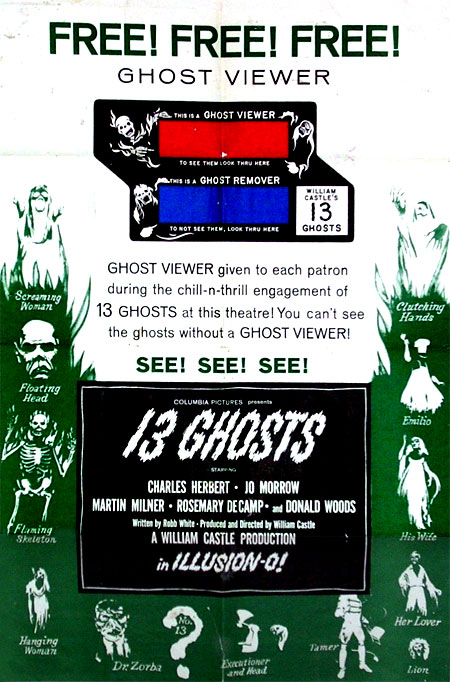
A poster promoting one of William Castle\'s movie gimmicks

In the 1950s the movie industry started feeling the competition from television. Enterprising producers started adding gimmicks that were hard to implement at home on TV. Widescreen formats became very popular in the 1950s, as did 3D.

It seems that the internet is the new competition to cinema. Film studios are starting to engage in an arms race of movie experience. If home viewers have access to screens showing movies at a resolution of 1920 by 1080 (2K) , cinemas will have screens with a resolutions between 4096×3112 (4K) and 10000×7000 (IMAX). If we have six speakers at home, cinemas will have speakers all along the walls.

The difference in the battle this time is that when people hear about great picture and sound and gimmicks such as 3D, they want to hear how it would work for them at home on their computer and TV. They aren’t so much into experiences that they can’t replicate where and when they want. We now expect technology to take the idea of the special occasion of going to the movies and make it everyday by giving us control. I imagine that if we could fit a collapsable rollercoaster into a backpack for easy erection anywhere we happen to be, we would forego the special occasion of going to a heavily branded theme park. We want special things in our lives, but can they be special if we have too much control over them?

That means we want 3D for our TVs, computers, phones, in-car instrumentation and product packaging. “It makes things more realistic” is the argument. It seems to make sense that one day, we won’t have 2D screens, just 3D projection everywhere: such as that employed by R2D2 in Star Wars.

Unfortunately, there comes a point when the benefit of the gimmick gets in the way of telling the story. If the way you tell the story becomes more important than the story told, then people might care a lot less about what you’re trying to say. If people are waiting for the next amazing special effect, huge sound, vibration in their seat or large 3D object seeming to poke them in the eye, they’ll be paying a lot less attention to the characters and the message. Some films are about the spectacle – the amazing effects, the original way of butchering a young woman, a breathtaking car chase. Better films may have spectacle, but they also have some thematic element that makes them last in the mind and heart. The Matrix may have introduced rarely-seen special effects, but people returned to the film because of the central concept and of the theme: ‘Is freedom possible?’ In Crouching Tiger, Hidden Dragon there are some exciting fights and stunts, but they are more exciting because sometimes you don’t know who you want to win the fight – you are on both sides at the same time.

Successful gimmicks are the ones that might get an audience to go and see a film – movie stars can be included in this category, but they don’t usually get in the way of the story. Some people may have gone to see Braveheart if Mel Gibson hadn’t starred in it, but he ‘opened’ the film. After that, it was the story and the theme that kept people coming back.

That means there are two possibilities for the future of stereoscopic 3D images on 2D screens: it is a fad that will fade away as battles between cinemas and the home move on to new fronts, or it will become so normal in film-making that people will hardly notice it any more.

I went to see “Lust, Caution” this evening. The film was great. Most of the film was in close-ups, but there were also some stunning wartime cityscapes.

The fact that big-budget movies can now recreate any city in any time-period cheers me up. In twenty years, there’ll be a simple piece of software that will be able to render any background onto any shot taken by a camera – moving as well as still. The world of 3D simulation for use in the home will start with flying over mountains in the Arctic or amongst the animals of the savannah. Eventually we’ll be able to take a walk down any street in any city in the world in any time period we choose.

City plans and photos and artists impressions and reportage will be combined to create these simulations. Brands in shops will be determined by contemporaneous photos cross-referenced by corporate archives. Streets will be populated by simulations of people based on photos taken at that time. Newspaper archives will be processed and combined with other databases into huge 4D models.

I’m looking forward to walking down my street in London on the day that I was born. Where and when will you walk?

As part of the review of every decision made by the Labour Government under Tony Blair, it seems as if Gordon Brown is trying to find a way of forgetting all about introducing mandatory ID cards for UK citizens.

As well as the privacy issues, the main stumbling block is the cost per card. The estimates start at £80 per card and higher. That’s the cost of the card with the technical and administration overhead. The card would replace the driving licence and passport, but people forget how much they cost. They might see the fee as another tax.

A solution – if you want one… – is to get the media companies to pay for it. They want the public to have a way of proving who they are so that their media will only play for those who have paid for a license. If the BBC’s content only plays for those with UK ID cards, people will be able to distribute the files as much as they want.

For an ID card to be acceptable in the UK, there has got to be a big benefit for citizens. I would say that having access to all the media you have the rights to see and hear at any time in any place would be a big benefit. For example if I had bought the right to watch any moment from Friends without seeing any advertising on screens up to 42″ in size, I could be with friends anywhere and simply prove who I am. The media should then be streamed to the nearest flat surface for our entertainment.

Maybe an ID is worth that convenience, so much so that people from other countries might want to buy in to the UK…