Archive

editing

I would say that all popularised 3D film technologies would be more accurately described as two and a half D. It’ll be a while before we’ll be editing “film in the round.” However, until then, my friend Jean has sent me an interesting document from IMAX on what to bear in mind when editing IMAX 3D (the IMAX format is known as ’15/70′):

Some editors screen all the footage in 35mm, sitting very close to the screen and concentrating hard — a demanding method, as the two formats look radically different. If something looks questionable, they order a 70mm print of that footage. Some print and screen their rough cut in 15/70. But, as Andy Gellis has observed, “If the film is working well on the Avid, then it will work like gangbusters on the big screen, as long as you calculate or calibrate the shot durations correctly. The brain can’t absorb the overload of information on the IMAX screen as readily as it can on the video monitor.”

Video will not give you an adequate impression of how the footage will look on the giant screen. For instance, if the eye has to move too far across the scene, a cut won’t work as well. Or in 3D, if the depth cues in successive shots aren’t similar then the brain will have difficulty fusing the left eye and right eye images. You may not recognize a spectacular 15/70 shot when seen in video. For these reasons, some video editors will rely more heavily on their 35mm printdowns, and selective contact printing of 70mm footage.

Occasionally, the reverse may be true. Stephen Low finds that “when you need to bamboozle the audience for a second to make a cut work and there’s something distracting on the edge, sometimes 15/70 is more forgiving than small formats, because (in 2D) you’re not as aware of the edges. A bad cut in 35mm or on video may be all right for the giant screen because peripheral vision is nowhere near as important, and the audience is more focused on the centre. And in IMAX Dome theatres, you’re not at all aware of the edge of the screen.”

Notes editor Barb Kerr: “You have to be even kinder to the audience in 3D, because their eyes are really focused deeply inside the picture. If you change the focal plane to something essentially above the head of the person in front of them in the theatre, you have to set them up to make that shift or it can be completely baffling or hurt them.”

From The 15/70 Filmmaker’s Manual from the IMAX site

Two floating 3D rings

I see in Gizmodo that Japanese researchers have found a way of heating the oxygen and nitrogen in the air to create plasma balls in mid-air. This may be the first baby-step towards true 3-D projection.

I wonder what cuts will feel like in 3D films. What would editing conversations be like? How would you direct a person’s attention from one person to another? What if your films will need to be presented in the round? Would would a car chase be like? Or a space battle?

The audience have barely touched their coffee.

We know where people will be looking when we have a 2D canvas to work with. How long before we learn where people will look at 3D films? I imagine that we will have longer shots. We’ll need time for people’s eyes to move to the new point of focus. Editors thought the same when widescreen formats were introduced in the 50s. How long before audiences will become ‘literate’ in this new visual language?

The first to know the answer wins a prize!

In New York, Allan Title gave a talk on how they edit ‘Dog the Bounty Hunter.’

He doesn’t call the show reality TV. It’s ‘fast cut verité’ – a non-narrated documentary. It covers the stories arising out of the lives of a family of Bounty Hunters based in Hawaii. The family that hunts bail jumpers together, stays together.

He said that they need to make sure that they don’t re-write reality too much. As they are dealing with police suspects who are about to go to trial, they need to be able to defend their programme to trial judges. If they play with time or change too much, the people in the programme can sue.

The show grew out of a series of individual documentaries on people who have interesting jobs. People audiences don’t usually get to meet. Allan has become a TV producer based on his editing experience. He says that documentaries need to be about people who are relatable but inaccessible.

As A&E have had a lot of success with the show (there have been over 85 episodes), they have a very generous production schedule.

1. Sequencers: Make up sequences that combine all the clips in order. They groupclip the multicamera sections.
2. Editors spend six weeks per show. Allan said that if they had narration to strcuture the show and also if they didn’t have sections that are edited to commercial music (the music video sections), then they would only need to spend three to four weeks a show.
3. By week 3 of the edit, they have a 45 minute cut for a 22 minute show.
4. By week 5 it is down to less than 30 minutes with almost all effects and music complete.
5. They allow a week for the changes required by standards and practices.

Dog is made at Hybrid Films in New York. Allan briefly outlined what he needs from trainees:

You start as a logger. Loggers get promoted if they can recognise what moments ‘pop’ from the rushes. Editing this kind of the documentary can be about taking footage that was not professionally captured and making it work. “You reveal your ability by making the unusable usable.”

Allan also said that you will spend a great deal of time with producers and other ‘higher-ups.’ This means that being an editor is like being a bartender or therapist. You have to be ready to talk about whatever they want to talk about.

Let discretion be your watchword.

I envy the community over at Cinematography.net. That’s where you’ll find the host of a group of mailing lists that I’m subscriber to. I only lurk on these lists, for they are for professional cinematographers to “talk and exchange ideas about cinematography.”

Every night I receive digest emails summarising the current debates amongst camera assistants, those working on full-resolution digital productions, working cinematographers and those needing to understand post production issues. Emails representing a small subset of all the lists you can subscribe to at cinematography.net.

“There’s something about Cinematographers, and the passion we bring to our work, that gives us a sense of being blood brothers. We have a love and admiration for each other, and a desire to help each other out” Conrad Hall ASC

It’s a pity that I haven’t found a similar place for editors to get together. What do editors need to ask each other? I guess we never need any help!

I suppose it’s up to us to create what we need.

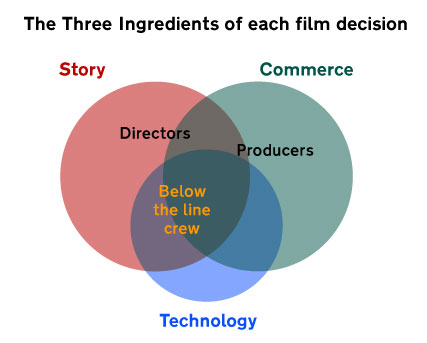
One of the things I used to look forward to be about being an editor was knowing the art of being an ambassador. You start as a translator, but as you get to know the other worlds with which you must interact, experience makes you an ambassador. I had this romantic notion that the editor sits mid-way between the worlds of ‘Story’ and ‘Commerce’ in the land of ‘Technology.’

Sometimes the ways of Commerce need to be explained to the world of Story. Sometimes the truth about Technology needs to be understood by Commerce. I thought that the editor should be prepared to think like the director when debating with the producer and vice versa. I now see that there’s no time for this sort of debate. The editor is there to implement the director’s vision using technology in order for the producer to reach the audience they want.

Editors need to understand the way directors see the film, producers see the film and what is possible to implement with the given technology.

I’m still interested in the combination of story, commerce and technology. I suppose all descisions made on a film will be influenced by at least one of these ingredients…

The best way to learn from editors is to assist them in their work. The problem with the current technology is that assistants no longer need to be at the editor’s shoulder. They used to have to be able to hand over any piece of film the editor would need to make the next splice. Now they are more likely to be working on a different computer on a task not directly related to making editing choices.

In an interview with Sean Valla, first assistant picture editor on Spider-Man 3 said that picture editor Bob Murawski is “good on his own” and that he has a sign on his door saying “If I want something, I’ll ask” (found in Avid Podcast no. 11).

In smaller productions, the deal should be that assistant editors work the technology to create the space for the editor to make artistic decisions. Picture editors shouldn’t have to think about ‘workflows’ (file formats, backups, media locations) – that’s administration. They should put themselves in the hands of an assistant to handle that. In return, if the assistant should have sometimes have access to the process and thoughts the editor have as they edit.

Over on Filmsound daily, production mixer Jeff Wexler says:

For many reasons… there has been a trend towards a disconnect between those working in production and those working in post.

He also talks about how there is less and less pre-production involvement for the production sound people. This means that a DP may like a given location, but if it will very difficult for the sound team to get a good result, it will cost a lot more further down the line in post to fix things.

There are times when someone on the set says something like “this place sound awful, Jeff’s not going to like this!” and I have to say, as nicely as possible, that if I don’t like it you have to be sure there are others far more important than me who also are not going to like it (the actors who may have to needlessly ADR a scene, the director who is going to have to get a good performance TWICE and probably 4 months apart, and of course the producer who is going to have to pay for it all).

Meanwhile, in the Editors Guild magazine, there was an op/ed(it) piece on the credits due to assistant editors:

Placing assistant editors in the post-production portion of the crawl is inaccurate and a disservice. We would like to call for the re-establishment of the correct placement of assistant editor credits. Namely, the editorial crew should fall behind the camera crew, which mirrors the editor and cinematographer main title credits.

I wonder if the extra responsibilities given to assistant editors in recent years mean the the job has outgrown it’s title? Would a new name for what they do help? It would be related to being a kind of post-production supervisor that starts their work during preproduction. Usually supervisors have authority of co-ordinators in post.

If assistant editors were known as ‘edit co-ordinators’ or ‘edit administrators’ would that better define their job? Would that give them the chance to move into post supervision? Maybe there is no problem here, and everyone has a very good idea what assistant editors do. I know that some people think that some film job titles are overblown enough as it is. Why don’t we have a picture recordist (‘director’ of photography) to go with our sound recordist (instead of ‘production sound mixer’)…?

I suppose production supervisors won’t listen to assistant editors any more or less than they would if their title was changed to ‘edit administrator.’

I think I’m reaching the limit of what a one-sided conversation can do… I may have to talk to someone about this… Serves me right for starting to write without a clear end in sight!

So having switched my reel to one with examples from drama productions, I gave a copy to my mother. When I next talked to my father, he mentioned my new reel. He was a little unsure about how his opinion would be received. “I’m not sure what this is. It’s some scenes from films. What did you do?”

A real compliment! All my parents saw was a scene from a mainstream comedy, a couple of indie movies and a documentary short. They couldn’t tell what I’d done. From their point of view, the reel scenes look ‘real.’ That’s what I was hoping for – that they were smoothly-edited enough that they didn’t notice an edit that was out of place.

For someone who isn’t in the business of hiring an editor, my demo reel is a little boring. I’ve shown it to a few people already. Once they finish watching, I like to explain a little about what I added to the process: “The first scene was originally six minutes long – made up of takes selected from eight different setups. I cut out the jokes that didn’t work. I added one… The third scene was made up of a single ten minute improvised shot of three people around a table – I cut the shot up to make it seem as if there were multiple takes of more than one setup… etc.”

My friend Donna suggested adding a short doc featuring me saying this accompanied by footage explaining my points. Even if people don’t need to know the background behind the work, they would be introduced to me as a person. My voice (and possibly my picture) might give people an idea of what it might be like to work with me – an important element of choosing who to work with. I haven’t decided yet whether this is a good idea yet.

Another idea would be to make a short montage that combines a much larger range of my work into a minute – accompanied to a piece of jaunty music…

…for now, I’m proud of my boring reel.

A couple of years ago, my good friend Laura gave me a birthday present. A present she thought might inspire me, but she wasn’t sure. It was Movie Mistakes by Jon Sandys. It is the book version of moviemistakes.com.

I think that this sort of site/book is a back-handed compliment to the art of editing. The kinds of mistake listed here are the ones you can guess: continuity (cigarettes jumping from hand to hand, getting longer and shorter between shots, food vanishing), anachronisms (visible edges of sets, visible crew) and many more.

I think that most contributors to the site and readers of the book think that the film makers managed to make these films without knowing the mistakes they were making, and that they would have fixed them if they knew. I guess that over 90% of the ‘mistakes’ found were well known to the people on set and to the editorial team.

The trick is to know what people are going to notice. There’s no point spending extra time and money fixing things that will only be spotted my the 0.1% of your audience who will be stepping through your film a frame at a time. As long as you know where people will be looking, you can have almost anything elsewhere in the frame – people aren’t going to see it. Also, if the emotion created by the writers, director and actors is compelling enough, the audience will forgive anything.

There are many elements that help make the edit between two shots invisible: consistency of emotion, the story advancing with the next piece of information, the rhythmic timing of the edit (the edit at that point feels ‘right’), knowing that if something vanishes that the eyes of the audience need time to find the next point of interest in the scene, that the composition of the shot on the screen doesn’t cause a jump cut (cutting to a shot that is too similar to the previous one), that people or objects in a scene don’t jump to a different position in the 3D space of the scene (continuity problems).

In In the Blink of An Eye by Walter Murch, he lists these elements in the same order as elements to consider when choosing when to cut and what to cut to. He gives (slightly arbitrary) percentage priorities to each element to show their relative importance: Emotion (51%), Story (23%), Rhythm (10%), Eye trace (7%), shot composition (5%) and 3D continuity (4%).

This shows that the emotions engendered by performance is worth more than all the other elements combined. That means, preserve the emotional line above all else. Neophyte editors take most pleasure in finding elements in each take that let them do continuity matches. According to experienced editors, continuity is the element that will be least noticed by an audience.

Cut for performance, not continuity.

Although film production is mainly about the combined work of specialists, we editors sometimes need do some of the work others are responsible for. We add titles, do simple composites, a little colourisation and temp mixes. This is to make test screenings run more smoothly. It is easier to show audiences ‘good enough’ titles, composites and so on without a lack of such refinements distracting people from the story.

This means we have to create our own temp mixes: add simple sound effects and temp music while balancing the elements to make the dialogue clear.

For a long time I wondered about the pan settings in Final Cut Pro. I found it odd that all the stereo tracks I imported had their pan set to -1. If they were mono, the default pan was 0. That meant that I usually set all stereo tracks to have a pan of 0. I didn’t want all the sound to be on one side of the mix.

It turns out that ‘pan’ for stereo tracks in Final Cut should be labelled ‘spread.’ A value of -1 means that all the information from the left channel in the source gets sent to the left output channel, with the right going to the right. A value of 0 sends both left and right channels equally to both outputs. A value of 1 sends the left content to the right output and the right content to the left output.

This meant that when I ‘fixed’ the pan of my stereo music and room tone effects so that their pan value was 0, I was making sure that the music and room tone sound came from the centre of the stereo field. That’s not a good idea if you want to make your dialogue clear: because for temp mixes, you should always set dialogue to come from the centre (0) with nearly everything else coming from the left and right (-1). That makes your temp mix much clearer.

I think it would be a lot clearer if ‘pan’ was marked as ‘spread’ when a stereo pair is loaded into the viewer. Pity that the value of normal stereo is -1, which is a trap for new users – which is probably too late to change now.

Edward Dmytryk’s 5th Rule of Editing: All scenes should begin, and end, with continuing action

Scenes should not start at the moment the actor starts his first action for the scene. Scenes should not end at the conclusion of the last action of the scene. The audience needs to get the impression that each scene is ‘a fragment of continuing life.’

This is a matter for experienced directors to allow for warm-up actions before the action at the start of a scene, and for editors to recognise these actions so that they know at what point in time to start. The examples Dmytryk gives are an initial walk across a set, sitting down or standing up or hanging up a telephone. Actors can use these actions to ‘get up to speed’ so that the context is set for the scripted content of the scene.

Extra actions at the end of a scene also help editors cut while the actor is in action, so that the audience is left without a complete resolution, a resolution they hope to find in the next scene.

From ‘On Film Editing’ – which is also available in an omnibus edition: ‘On Filmmaking