Archive

editing

Syd Field says that a good guideline for where to start a scene is two lines before the purpose of the scene is revealed. That’s the latest you can start.

The purpose of each scene is defined as knowing what the protagonist of the scene wants. The protagonist of the scene may not be the protagonist of the film. It could be the antagonist or a supporting character.

You should finish scenes as soon as the audience knows whether the protagonist of the scene has either got what they want or as soon as they are denied. Why stay any longer?

If it hasn’t been written that way, editors can fix it in ‘the last rewrite’.

Walter Murch has a rule about how much you can practically reduce the running time of a first assembly. This reduction is a little like reducing a patient’s weight. You can slim them down with diet and exercise and a lot of hard work, but there are limits.

Murch’s limit is a 30% reduction. If you have a 3 hour 20 minute film, you can reduce the running time down to 2 hours 20 minutes by trimming scenes, finessing edits: taking what you have and making it play more efficiently. If the distributor requires a running time of less than 2 hours, more drastic actions are needed. Plotlines need to be taken out, entire characters removed.

So be aware that a 120 page script may sometimes expand to a 160 minute film, but cutting the movie down to less than 115 minutes will require serious surgery. That’s why you’ll discover that your story will survive with a single kidney or lung, or even eye…

My friend Matt invited me to check out Kaltura, a communal video editing community (Their main site doesn’t support Safari so Safari users should take a look at their blog).

Their current plan is that you join up and initiate projects that can be shared with whoever you want. You come up with the kind of video you want to make, upload some clips, and invite people to add clips or make their own edits.

The concept is that this site gives access for ‘normal people’ to the tools for them to collaborate in editing films. More than one person can upload footage, more than one person can edit.

A Kaltura on kaltura.com

Each ‘Kaltura’ is ‘a community of clips and edits’. If you are a fan of a band, you could set up a site where you and others can upload clips and make fan videos. If you want to make a campaigning video, you can add clips of footage that might help get the message across.

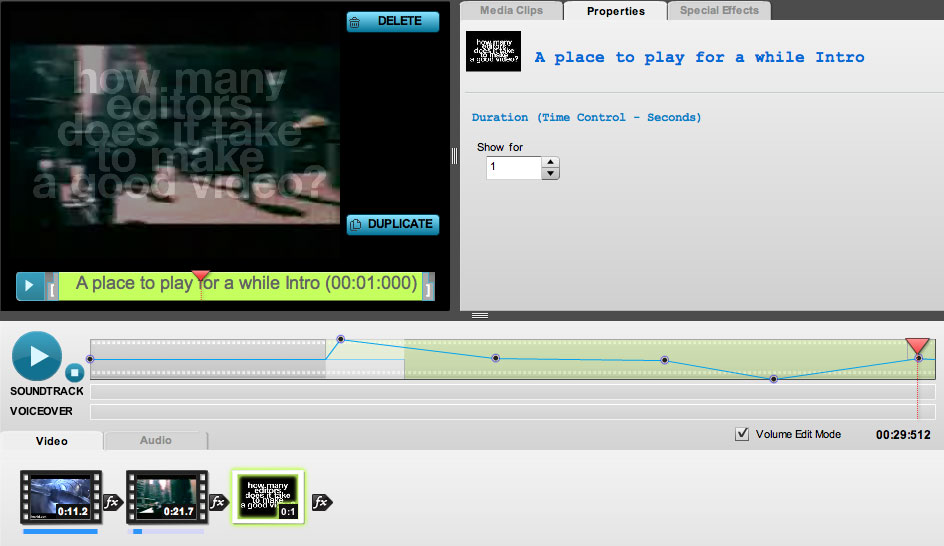
Kaltura editor

The video editor looks like an early version of iMovie. It’s flash based, so there don’t seem to be any keyboard shortcuts or mouse shortcuts.

Or an Undo feature.

All footage is assumed to be 4:3 ratio. There are a variety of transition types. You get one layer of video (with a text overlay channel) and three sound channels: from the clip on the timeline, a channel for music and effects (they need to be bounced down to a single file) and a channel for voiceover.

Do projects benfit from multiple editors? Could this be used for a team collaborating on edits? If this is offline resolution, how do I get the EDL so I can do the online?

…and when will they support Apple Safari?

Alan Heim, editor:

The editor, the assistant, and the apprentice have been together for, say, there months. You’ve been sitting there looking at this material and occasionally muttering under your breath, being unhappy about it in some way, and suddenly, here’s the perpetrator. You’ve got certain loyalty and the director is now an outsider. You get to the point where the editor has to make the director feel comfortable in the cutting room.

Also from Selected Takes:

There are ways of getting your view across without challenging the original concept for the film. The whole process is a compromise and you have to be willing and able to get other people to compromise. That often leads to some tensions, and you’ll lose a lot of the fights. … I can work on a film and be tremendously intense about it, but after is said and done, it’s the director’s movie. At some point you have to be willing to give up and let the director do what he wants to do, even if you feel it’s not right.

He edited Network, All That Jazz and American History X. If you’re in New York on Thursday 27th September, you can ask him your own questions as part of the Manhattan Edit Workshop’s series of seminars with distinguished feature film editors. The event is free, it starts at 7:30pm sharp at the Helen Mills Theatre, 139 W 26th Street. RSVP to The Manhattan Edit Workshop.

Listening to the current Filmspotting podcast (web/iTunes), I heard an interview with Guy Maddin. He was talking about an impressionistic documentary that he was commissioned to make about the town he grew up in: ‘My Winnipeg.’ At 18:25, he starts to describe how he constructed the film. He didn’t know how to structure the film, so he took his inspiration from the way his editor is sometimes inspired by temp music. He went into a recording studio and started to extemporise on the theme of his home town. Sometimes he would prepare a few words, sometimes he would go off on tangents. These recordings he gave to his editor:

My editor treated that as ‘temp music’ – temp narration. He would cut it up – sometimes space it out more and rearrange the words… Before we finally fixed it up, there would be inconsistencies with verb tenses and grammatical things because he was making a collage out of my narration just the way he would hack up some Mahler when we use it as temp music… So that a piece of action would happen on a cymbal crash or something like that. … I didn’t re-record much more than a couple of sentences to smooth out some inconsistencies…

In the UK there have been a series of TV scandals. Scandals that pundits say have ‘eroded the public trust in television.’ These scandals range from people entering phone in competitions on premium-rate telephone numbers with no chance of winning to a documentary about Alzheimer’s that implied that the subject had died on camera when they went into a coma that lead to their death three days later.

The latest kneejerk reaction has been that a UK TV channel has banned the use of a majority of the cutaways regularly used in TV news.

At the moment news programmes are peppered with what Five’s news editor David Kermode describes as “rather hackneyed tricks”. He’s referring to interviewer ‘noddies’ and question asking shots that are recorded after the interviewee has left the scene. He also is banning the generic silent shots of interviewees walking down corridors and walking into offices. These are the shots that reporters usually add a voiceover to to provide story context. Kermode calls these “contrived”.

He said viewers “have a pretty good grasp of what an ‘edit’ is, so I think the time has come to be honest about signposting when we edit our interviews”. That shows that he doesn’t understand the need for storytelling techniques in communication.

This ban is supposed to restore viewers’ trust in TV news… However I’d be surprised if any viewers have noticed any of these ‘tricks’. They’ll notice interviews made up of interviewee shots crossfading from clip to clip.

It’s surprising that the general public’s trust in British TV has lasted this far into the 21st century. I think that TV companies should forget about trying to regain that trust with empty gestures and get on with making good TV.

The BBC’s Newsnight show is asking viewers whether this ban is a good idea. There’s a good set of responses to that question on their website.

Editing is like everything else. It’s a reflection of how people think about their times and how we react to the medium. You can look at a film made in the 1960s and know if it was made in 1963 or 1969. Editing is a lively art and it changes with the seasons. So we’re always going to have something new and something unusual coming up.

Carol Littleton.

Hear more from her in the Vault at the Manhattan Edit Workshop. You can use their flash-based site to get to the Vault, or listen via iTunes.

You should bookmark Norman Hollyn’s blog. Why?

He wrote The Film Editing Room handbook. All you need to know about how to set up and maintain all the technical aspects of editing feature films. He starts with pre-production and follows the process through to the answer print. As well as technical issues, he also covers how to deal with those you need to interact with: The camera department, the director, equipment suppliers, telecine companies, effects houses and the sound editors. You learn what information you need to supply them, and what they expect of you.

He is responsible for the teaching of editing at USC (now known as the USC School of Cinematic Arts). He developed the courses that the prospective editors, producers and directors take to learn editing from first principles. You can hear him talk about editing in film schools on these two Avid Podcasts: web part 1, web part 2 (iTunes part 1, iTunes part 2).

His blog is a great place to keep up with debates on the place of the editor in film making.

As editing is about storytelling, we can learn from what we leave out from the stories we tell. The moments that aren’t directly required to relate our tales are left out. Dreams are stories that our unconscious mind tells us so that we learn the lessons from the experiences of the day. When I wake up still remembering my dreams, I write them down. What I write down ends up being an ultra-distilled story. A story that is sometimes difficult to understand. It’s the distillation that is interesting for editors.

In our day-to-day lives we don’t experience jump cuts from home to work, or from starting a job to sharing in the results. On the other hand, that is the way we remember our lives. This is why picture editors can splice two scenes together and make the join invisible. ‘Training montages’ work for audiences because we summarise hours and hours of practice and effort in the same way – the way they are summarised in a montage.

Ingmar Bergman:

“No form of art goes beyond ordinary consciousness as film does, straight to our emotions, deep into the twilight room of the soul”