Archive

Alex

mouth
My new input device

Following up Google’s voice-operated iPhone search application, maybe it’s time we started to think about non-visual interfaces for our technology. We’ve seen them depicted in Star Trek and sci-fi stories for decades. They show heroes of the future engaged in conversations with technology.

I think that children born ten years from now will find our obsession with visual interfaces quaint. UIs are still centered around ‘the document’ – the system used by corporations in the 18th and 19th centuries to organise colonial empires, and by educational institutions to formalise schooling.

It may be that technology will eventually help us come up with a new technique to pass on and store knowledge. Do you conceive of what you know in terms of words and pictures written on documents? That’s not the form I use to maintain my model of the way my world works. Documents (such as this blog) are a transmission method. We may be able to come up with something more effective in the coming decades.

The late 19th and early 20th century and introduced electricity-powered motors to middle-class people’s lives. Clothes are washed and dried using spinning motors. Refrigeration works using heat pumps. The reason why alternating current was chosen as the method for delivering electricity to people’s homes was that motorised devices need AC to work. As the decades went by, electric motors became hidden, less noticeable in everyday use. Technological methods recede into the background as the services they deliver evolve into utilities. Few families have their own electricity generator, water pump and sewage treatment works any more.

In the same way, computers eventually will fade few view, and our connection to the rest of the world will through a voice whispered in our ears and our instructions will be whispered so no-one else can hear. Nearby surfaces will be used as displays for images and video, but probably won’t be the primary method for technology interaction.

There are a few trends that may lead us in this direction.

The idea behind ‘cloud computing’ is partly about getting people and organisations to let go of having a specific place for a document or unit of computing power. We pay for a service that handles making sure that the documents we have are safely backed up and instantly available where we are in the world. The cloud also provides computing power; when an online service starts getting bogged down with consumer requests, it can call on Google’s cloud of computing power to help out for a few hours. We don’t need to know which power station produced the electricity that is keeping out lights on at night, as long as the power is there when we want it, eventually we’ll trust that the cloud holds all the information we’d like to have access to anywhere. It might be easier for us to tell our technology to do what is needed to get us through the day: “Tell this new bank what it needs to know for me to open the new account.”

The natural language interfaces that have been evolving for the last ten years will eventually become that ‘personal digital assistants’ that will spend their time looking after us. For example I Want Sandy currently uses email to communicate, I assume they’re working on a voice-operated version for mobile technology.

Think about how important needing to find or create ‘the right document’ is for us all today. Eventually something will come along to replace this need. Such is the the nature of technology: in the long run it makes every generation feel out of date.

It is time to turn to the educationalists and see if they can come up with something better…
Apple have had their success with iTunes partially because the pricing model is so simple: 79p per track, £7.99 per album. They delayed launching video because they wanted something as simple for movies and TV shows.

People don’t want to have to remember more than one price for a TV show or a movie. When they are about to choose which to buy, they want to be sure how much they’ll be paying.

To those owning the films and programmes, they want to charge more if they think they’ll get people to pay. Recent releases are worth more than catalogue titles. Recent releases need to be paid for too.

However I think there will be a market for pricing based on the size of the potential audience of the video. A video kept for reference and watched every once in a while by an individual could be priced lower than one shown to over 200 people at a private club.

If that is so, why not charge based on screen size instead of resolution. Imagine paying less for a video than can only be shown on an iPod Touch or iPhone than one that that those devices output to TV.

The tradeoff between the content owners and consumers could be based on the implied audience size associated with a screen size. It would be uncomfortable for many more than one person at a time to watch an iPod movie. Not more than 30 would want to watch a consumer-based HD display at the same time…

I vote for cheap movies for people with no friends, they deserve something to make up for the loneliness!

In seven years, it’ll be 2015, when the events of Back to the Future part II are set. Blade Runner is set four more years after that. I don’t think we’ll have flying cars for individuals or emotion-riddled robots, so what will we be doing with all that computer power.

Given that the computer I’m using now has 4,194,304 times as much memory than my first home computer, and probably runs that many times faster, and the rate of acceleration of computer power, it’s fun to think of what a computer a million times faster with a million times the memory could do.

How about this:

Imagine combining a MRI scanner with 3D modeling software to convert all our analogue archives to digital. Once scanners are able to recognise a wide range of molecules and accurately detect their position in three dimensions, I foresee a device that you could rent to scan your personal archives.

Imagine a cardboard box full of photos, scribbled notes, floppy disks, magazines and ticket stubs. If the scanner was good enough and the software smart enough, all the information in the box could be converted to digital formats.

The simplest to convert would be the digital media. All the molecules, their positions and their magnetic fields in a pile of old floppy discs, laserdiscs, SyQyest, Jaz, Zip or hard drives could be recognised and converted.

Then the position of the paper would be found. Then the ink molecules on the pages of the notes, books and magazines would be investigated. From the curve of the paper, the words typeset, printed and doodled could be compiled into separate files. The chemicals in the photos could be read so that all the colours can be combined into digital images (whether on photographic paper or on undeveloped film).

Imagine how much recycling could be possible if we knew that all the information stored in all the archives, governmental, corporate and personal could be preserved without all the boxes and boxes of stuff that we keep hanging around.

Instead of the paperless office, would could have paperless lives… at least we could choose exactly what we wanted to have on paper and no more.

PS: For those predicting the total collapse of technology, civilisation and knowledge; paper still isn’t good enough. For those seeking ten-thousand year solutions, visit The Long Now Foundation – which includes The Long Server.

Harriet weaned me off puns in my daily life, but I couldn’t resist that one.

Went to The London Frieze Art Fair today. It’s the first time I’ve been near Frieze since working with Tony Arefin back in 1988 on a Yoko Ono poster.

Although the ‘Fair’ name might tempt you to think that this is a place where the general public might be able to buy art, this event is more like a instant teleport device between the top 150 art galleries of the world.

Although I bought my debit card with me, I’m not in the market for £20,000 pieces yet – and those prices are for the up and coming artists.

As well as the galleries, Frieze also commissioned a few art pieces themselves. Some were more obvious than others:

The show inspired me to come up with the following ideas (from my notes taken at the event):

Art La Ronde
Blonde survey
Containers
Odder research
Crutch ski-ing
Bedroom tag
Curtains for Bill
Famous Welsh
Straps close up
Archaeological layers
Hoods
My map
Sync clocks?
Location icosaheadron

The fair runs until Sunday 19th October. If you go, I hope you are as inspired as I was.

Just when the world’s advertising and media companies think they’ve got a handle on using the internet to build and maintain relationships with millions of people, a new disruption might be on the way. Everyone might have to get into the software business.

An example: Soon Major League Baseball fans will be able to download an application to their phones that will keep them up to date with games as they happen. Using pictures as well as text. And video clips showing replays of the action moments after it happens. This is an application that will be available on the iPhone within the next few months.

Instead of going all over the web to buy music, you can visit one of the very few digital online music retailers – such as iTunes. The more these services act like software applications, the more successful they are. iTunes and similar software may go to the internet to find songs and videos, but the places it goes doesn’t matter to those searching for music.

These are the sort of services people will start to expect on their phones. If Apple’s iPhone, Google’s Android (an operating system for telephones – coming soon) and Microsoft’s (they won’t be able to stay out of this) products take off, people won’t expect to jump from page to page any more. They’ll expect government, corporate, social and individual entities to provide services that represent the relationships the entities want to have with their audience.

Governments will provide a service to manage citizens’ relationship with their society. How much tax you pay, how many expenses you can claim, which state you spend the night, what benefits you deserve, what rights you have.

Corporations would have to express themselves by what they can usefully do for their audiences – if anything.

I imagine that some blogs will evolve into avatars. The things we write, the pictures we like, the way we turn a phrase might one day be converted into a digital representation of ourselves. We’ll have the option for our blogs to speak for us if we are too busy to get involved in a conversation.

Will the web of linked pages that most people identify as the internet still be around in five years time? If not, will applications replace it?

More handheld time lapse doodles. Click the Vimeo for an HD version.

There are many edits in this video to make the footage match the music – mainly speeding up and slowing down the picture. I was barely on time for an appointment, so my route was pre-determined. Sadly that meant following a stranger for a few minutes. It was a coincidence! Click the Vimeo for an larger version.

This one is a video version of the Victorian saying: ‘I didn’t have time to write you a short letter, so I’m writing you this long one.’ I wanted to post the video the same day as I shot it, so I only had just over 30 minutes to do the edit. Click the Vimeo for an HD version.

George Blackstone and I made The Things We Do for Love, a documentary on dating and relationships. It is made up of interviews with many people of all ages. A recent task I had was to make a DVD so that the contributors who couldn’t reach a screening would have a chance to see the film. I also planned to put alternative edits and bonus footage on the disc.

As I was putting it together, I realised that it might be better to make all the content I was generating available online. That is the modern way. So instead of building my menu system, I’m uploading the files to Vimeo.

Vimeo is a site where all the content is generated by the people who post it. As well as standard definition video, they host HD (be in 720p24, 720p25 or 720p30). They have an upload quota of 500MB a week. The great thing about this quota is that it encourages you to use it. Those camera tests and technology demos can now be hosted on a free site with minimal advertising.

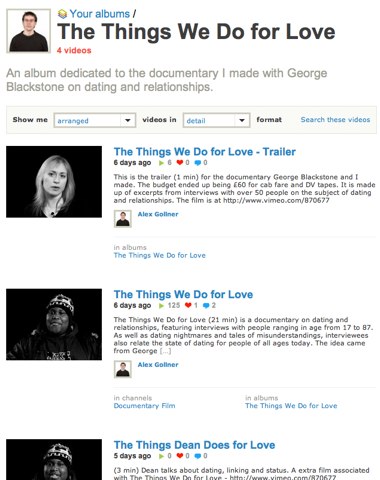
Videos and pictures that you upload can be grouped into albums, where content on a specific theme can be gathered together. I’ve grouped the videos associated with our documentary in an album called The Things We Do for Love:

http://www.vimeo.com/album/11274

In the coming days I’ll upload more bonus footage. The videos are smaller than SD for now because Vimeo sees 1024 by 576 PAL widescreen videos as being less than 1280 by 720 HD, so encodes them at a smaller size (for now). We shot at SD and I couldn’t fit a scaled up HD version into my weekly 500MB quota.

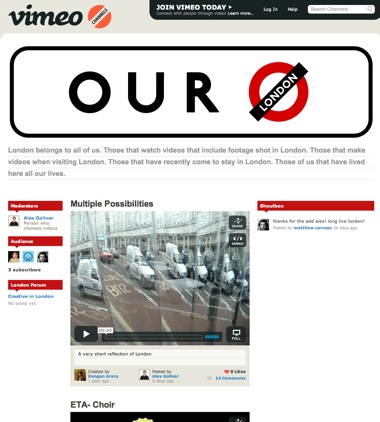
Another feature of Vimeo is ‘Channels’ – this is where users curate a channel of videos on a chosen subject. As well as their own videos, they can choose to include other people’s videos. This feature is more about community building – people can post messages that appear on the home page of the channel, and there is an option to include a forum for people to discuss the content of the channel – or anything else they fancy.

Mine is called ‘Our London‘ – it’s a collection of videos featuring London.

A screenshot showing a channel in Vimeo

I imagine many companies are trying to create the ‘Super YouTube’ – this one will do for me for now.

This seems to be the number of titles on the Internet Movie Database right now. Not as many as I expected given that they now include individual episodes of many TV shows. I got this number by finding the highest number that works in the address field for title: http://www.imdb.com/title/tt1168191/ works, http://www.imdb.com/title/tt1168192/ (or any higher number) as of 1744 GMT on January 10th, 2008.

This reminds me of the last page on the internet.

The last person on the imdb is Darren Booth. Odd that there are less than 3 million people listed.