As the London tube system will only get more complicated, maybe it is time to consider using an idea from the Paris Metro: make more of names of the terminii of each line. I think that one of the biggest problems for new users of the system is the use of compass-point directions (‘Eastbound and Westbound’) at tube stations.

Sometimes I need to change at Westminster. When I do, I see that the Jubilee platforms are labelled as being for trains going ‘Westbound’ and ‘Eastbound’. Surely from the point of view of most Londoners, certainly for those who navigate by the tube map, the Jubilee line goes north-south at that point, and the sub-surface lines east-west. The District and Circle aren’t marked as going Northbound and Southbound at Westminster (which are the directions it travels at that station).

Both the Jubilee and Bakerloo lines leave Baker Street to the east. Their platforms aren’t described as Eastbound.

Signage could look like this:

With a revised (2012) tube map looking like this:

The 2012 tube map with the teminii emphasised
Click to enlarge.

…so the director asked me for my opinions on the 1st assembly of his documentary.

It was scary. Why? Because it was a documentary on the adventures of an English brain surgeon’s mission to the Ukraine. Not too worrying in of itself. But as this wasn’t appearing on TV or at a film festival yet, it was unmediated. Standards and practices hadn’t approved it. That meant that anyone being operated on could die. That meant that there could be any number of gory shots of surgery – without any sort of warning.

The worst shot I witnessed was the point where a serrated thread was being used to saw through a man’s skull. The surgeon moved the metal band back and forward – it was covered in blood. Just the sort of thing you don’t want to switch over to when flipping channels.

This meant an exciting watch for me, but helped me realise how comforting mediated media is. I feel safer if someone has checked what I’m going to watch. That could be a TV station or a festival programmer. That’s why classification of content is a good idea. I don’t want content censored, I’d just like to have a good idea of what I’m in for.

Who will you turn to on the internet to mediate your media?

*Mediated – connected indirectly through another person or thing; involving an intermediate agency

Why do most remakes not work? Why were the recent versions of ‘The Italian Job’ and ‘Alfie’ flops? Will the new version of ‘The Taking of Pelham 1-2-3′ surpass the original?

Screenwriters hit the big time if their script is on the zeitgeist. The zeitgeist is the dominant cultural perspective. To be ‘on the zeitgeist’ is to mark the change in this perspective. Rock and Roll occurred when the increase in disposable income in children created the concept of ‘the teenager.’ Punk happened when idealistic people realised that the hippies weren’t going to change anything that mattered.

The cultural consensus shapes and is shaped by cultural artefacts: art, drama, music, writing and film. Films that are part of an old cultural consensus cannot rely on the same philosophical identification when remade for a new audience.

That means the ideas that will be the biggest hit in a couple of years time will be ones that predict the cultural consensus at that time. Luckily most new movements come from the same place. What is underground today will challenge the conservative mainstream of tomorrow. That means you might have to listen to new music, seek out new writing, indulge what you might consider superficial – the fashionable and the cool.

They don’t all sound the same!

…because they are made on a small screen! He also credits ‘I am Legend’ as the source for Night of the Living Dead, although he had to change the vampires to zombies because vampires had been done before. He’s in town to promote The Zombie Diaries at the London Film Festival.

Until November 5th, listen to an interview with him starting one hour into this two hour BBC local radio broadcast.

Fairytale story: Student Nick Haley creates his own advert for Apple’s new iPod Touch. He uses Final Cut Pro to edit material he finds on http://www.apple.com:

Apple gets in touch. Instead of the usual takedown notice, they ask him if he wants to visit Silicon Valley to collaborate with them to create a broadcast version of his advert:

(from applegazette)

Walter Murch (The Conversations):

When you’re putting a scene together, the three key things you are deciding, over and over again, are: What shot shall I use? Where shall I begin it? Where shall I end it? An average film may have a thousand edits in it, so: three thousand decisions. But if you can answer those questions in the most interesting, complex, musical, dramatic way, the your film will be alive as it can be.

For me, the most rhythmically important decision of the three is the last: Where do you end the shot? You and it at the exact moment in which it has revealed everything that it’s going to reveal, in its fullness, without being over-ripe. If you end the shot too soon, you have the equivalent of youth cut off in its bloom. Its potential is unrealised. If you hold a shot too long, things tend to putrefy.

On the subject of what multi-touch interfaces will be manipulating in the future…

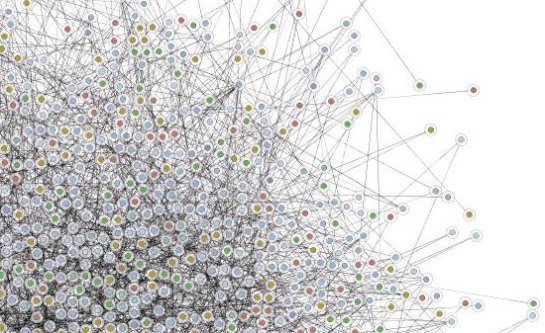
A network of people, documents or ideas

I have recently been working with a company that combines databases together to build ‘social networks’ – to model the way groups of people in society interact. This would be useful within organisations and projects too. If the connections within a project can be generated automatically, they’d be more useful…

I guess there’ll be some sort of three dimensional concept browser that will represent an individual’s model of their understanding and interaction with a project. Each member of the project would see a different view of the project. This is the sort of thing that will gain from direct (multi-touch-supported) manipulation.

Matt Davis, video producer and teacher sent me a link to Celtx – a free software suite for screenwriters, directors and producers for Macs and PCs.

Free media production software from Celtx

You write your outline in the text editor; fill in index cards; write scripts; produce character, prop and location lists; organise storyboards and schedule your production.

The software is free. The publishers make money by selling web services to film makers. Looks like a good deal.

The people who spend their time debating the Final Cut vs. Avid argument should know that this battle wouldn’t be happening today if Microsoft didn’t try and bully Apple into dropping QuickTime for Windows.

For a good summary of the story, visit Roughly Drafted. The site was recently redesigned, so visit the new location for some deep, deep Mac fandom.