Ben Affleck. Pretty-boy actor with a mildly interesting love life, right? I recently listened to a podcast that reminded me that he is also an Oscar-winning screenwriter.

In ths podcast from Creative Screenwriting Magazine (iTunes, mp3) he is promoting the film he co-wrote and directed Gone Baby Gone. He covers many screenwriting subjects very quickly including how to adapt the fourth in a series of books as if it were the first, and the many advantages of speaking your dialogue to see if actors can say it:

15:50 – “Writers think about dialogue as ‘getting from A to B’ or having some thematic connection to something. None of that means anything if it can’t be delivered in a way that works. […Sometimes] it doesn’t sound like a human being talking”

If you haven’t seen the film, make sure you stop the podcast at 21:05 as there are huge spoilers for the end of the film.

A few days ago a client asked me to put up an edit on my site so that any visitors could not download it for later review. She wanted people to look at the edit in situ. That meant creating a Flash version of the QuickTime movie and uploading it instead.

My friend Matt Davis told me how. I have software for creating Flash versions of movies, but not the player to embed on a web page. People are used to pausing, rewinding and replaying videos. They also want control over the volume. Luckily there is a player available for free on the internet.

Here’s how to make a web page to play Flash FLV files.

    Go to Jeroen Wijering’s website.
    Download the JW FLV player.
    Export your movie as a Flash 8 FLV file.
    Name your video video.flv
    Create a preview .jpg called preview.jpg
    Upload the flash video, the preview picture, the flvplayer.swf file, the swfobject.js javascript file and an html file to your website.

Here’s a version of the html file I used:

<html>
<head><script type="text/javascript" src="swfobject.js">
</script>
</head>
 
<body>
<p id="player1">
<a href="http://www.macromedia.com/go/getflashplayer">Get the Flash Player</a> to see the video.</p>
<script type="text/javascript">
   var s1 = new SWFObject("flvplayer.swf","single","1024","596","7");
   s1.addParam("allowfullscreen","true");
   s1.addVariable("file","video.flv");
   s1.addVariable("image","preview.jpg");
   s1.addVariable("width","1024");
   s1.addVariable("height","596");
   s1.write("player1");
</script>
</body>
</html>

My source movie had a resolution of 1024 by 576. In the html, you can see the dimensions used are 1024 and 596. I added 20 pixels to the height for the controls of the player.

Mr. Wijering also has a setup wizard that can generate the html for you, based on settings you provide. For more support, go to the Support section of the JW FLV Player page.

There follows a footnote from a book published and printed 187 years ago. I found it in my parents’ library.

Queen Caroline’s trial - book title page

Title: The Legislatorial Trial of Her Majesty Caroline Amelia Elizabeth, Queen of England, Consort of George the Fourth, for the Alleged Crime of Adultery with Bartolomeo Bergami.
Printed and published by H. Rowe, 1820.

A footnote on the fandango

The Solicitor General: Do you remember a person of the name Majoretto or Mahomet, being in the service of the Princess?
Theodore Majocchi: Yes
SG: What countryman was he?
TM: He was from Jaffa
SG: Did he come on board the Princess’s vessel at Jaffa?
TM: Yes
[…]
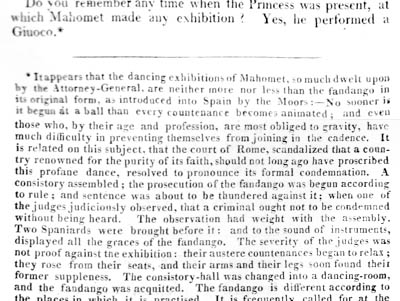
SG: Do you remember at any time when the Princess was present, at which Mahomet made any exhibition?
TM: Yes, he performed a Giuoco*

*It appears that the dancing exhibitions of Mahomet, so much dwelt upon by the Attorney-General, are neither more nor less than the fandango in its original form, as introduced into Spain by the Moors:- so sooner is it begun at a ball than every countenance becomes animated; and even those who, by their age and profession, are most obliged to gravity, have much difficulty in preventing themselves from joining in the cadence.
It is related on this subject, that the court of Rome, scandalized that a country renowned for the purity of its faith, should not long ago have proscribed this profane dance, resolved to pronounce its formal condemnation. A consistory assembled; the prosecution of the fandango was begun according to rule; and sentence was about to be thundered against it; when one of the judges judiciously observed, that a criminal ought not to be condemned without being heard.
The observation had weight with the assembly. Two Spaniards were brought before it: and to the sound of instruments, displayed all the graces of the fandango.
The severity of the judges was not proof against the exhibition: their austere countenances began to relax; they rose from their seats, and their arms and legs soon found their former suppleness. The consistory-hall was changed into a dancing room, and the fandango was acquitted.

These set of colours mean a lot to Londoners:

London's tube line colours

It’s a piece from Art on the Underground. They’ve been commissioning temporary artworks for London’s tube system since 2000. Their main space is a disused platform at Gloucester Road underground station:

Brian Griffiths 'Life Is A Laugh' - until May 2008

They’ve got a new plan: to commission permanent installations throughout the system. About time too. The New York Subway has been doing this for years. I enjoyed the following two:

Link to a site on NYC Subway art
Bronze figures playing on the platforms More pictures from the same installation.

Link to a site on NYC Subway art
Walls slid to reveal mosaics
More pictures from the same installation.

Here is part one of my expanded notes from the Soho Screenwriters meeting on elements of the thriller genre.

Thrillers are about ordinary people in a recognisable world. Their jumping off point is the human condition. Of the mainstream genres, it is closest to drama. Despite this realism, in order for the machinations of the plot to work, thrillers are the most contrived sort of film.

The classic thriller

The antagonist has a scheme – they don’t know about the protagonist-to-be. The hero stumbles onto the conspiracy. They try to fix the situation. Their flaw leads them into more and more danger instead of making themselves safer. Eventually the antagonist must kill the hero for their plan to succeed. The audience must identify with the hero’s struggle to stay alive – “It could happen to me!”

The hero doesn’t have any special abilities or powers – more like the audience. They would never kill anyone. Their disbelief drives them into the plot. At the turning point they abandon naiveté and embrace reality. They eventually kill in defence or on behalf of others. Their ‘license to kill’ comes is granted by the audience.

Trapped in modern society. The collapse of the world as the hero knows it. A fish out of water. Isolated physically, isolated psychologically (through betrayal). Greatness is thrust upon them. Needs to sort themselves out (psychologically) before sorting the story.

Story takes place over a specific compressed short period of time. 90 pages is enough – good for budget and scope. Set up a clock: A bomb, an assassination. Further into to the story, the spaces and times contract in each scene. Kyle MacLachlan in Blue Velvet ends up in a closet.

1. Welcome to hero’s ordinary world
2. Event forces them to see dark side of community or institution
3. Seeks help from friend
4. Friend turns to be untrustworthy
5. No-one can be trusted – Hero alone to fix problem
6. The hero fixes themselves
7. Act 3: Antagonist on the back foot
8. Hero wins

Irony

Two plots are needed: What appears to be going on – and what is actually going on. Thrillers sometimes let the audience know what the characters don’t know.

North by Northwest: Irony – we know she’s a baddie, Irony – we don’t know that Kaplan doesn’t exist, Irony – we know she hasn’t killed him at the ski resort, Irony – we don’t know that the baddies know about the blanks in the gun.

Looks like editors of factual TV productions in the UK have a new kind of client to deal with. The ‘Edit Producer.’ I noticed this credit roll by on a TV show this evening. I wondered if the emphasis was on ‘edit’ or ‘produce.’ If it is an editor who supervises or produces the edit of a series with the help of different editing teams, or it is a producer who is solely responsible for producing the edit. I hoped it was the former. It turns out to be the latter:

With factual reality shows, the producers who were on set during the shoot will typically run the edit. This is because there is a huge amount of material and you need someone who was very close to the action with the editor to ensure nothing gets lost. Thus they will be credited as producers and so the term edit producer won’t be used. However with gameshows the edit is often run by someone who was not part of the production of the shoot but is brought in because they have a flair for assembling linear material into something compelling. A bit like a good record producer. The fantastic Adam Wood, who I had got to know well on Playing it Straight – he was the executive producer – was kind enough to think I could make a good fist of the Cash Cab footage that had been shot, so he called me and I came in to cut the establishing episodes. In fact, I’m proud to say that I cut the pilot that Adam used to sell the show worldwide.

(from a UK gameshow blog)

If the Edit Producer is the one with the “flair for assembling linear material into something compelling,” I wonder what the editor’s role is?

Stephen King thinks that plot is

The good writer’s last resort and the dullard’s first choice. The story that results from it is apt to feel artificial and laboured.

I lean more heavily on intuition, and have been able to do that because my books tend to be based on situation rather than story. Some of the ideas which have produced those books are more complex than others, but the majority start out with the stark simplicity of a department store window or a waxwork tableau. I want to put a group of characters (perhaps a pair; perhaps even just one) in some sort of predicament and watch them try to work themselves free. My job isn’t to help them work their way free, or manipulate them to safety […] but to watch what happens and then write it down.

I haven’t read any of his novels, but I think that Stephen King is probably a very good writer (despite his popularity). I don’t think what he says here applies to screenwriting, but it provides a guide to an alternative way of finding your story: trust your intuition.

The great thing about being out and about in a multicultural city is that you have plenty of options to practice editing. Unlike my parents and many of my friends, I only understand (almost) one language. There is a silver lining to this cloud. When people around me speak any language but English, I don’t understand what they are saying.

When people are having conversations in languages I don’t understand, I can practice my editing. I do this by looking at each person in turn, choosing when to look from one to the other based on where I would edit. As I do not understand what they are talking about, I use the body language and eye-trace of the people involved. It works fine when two people are face to face on a train. It works better when three are sat a little further apart.

A great deal of editing dialogue is making the edits invisible by showing the audience exactly what they want to see when they want to see it. If you cut to someone thinking about what is being said at the moment the audience wants to know what they are thinking, they will not see the edit. They will take the time to absorb how the person not speaking is reacting.

It turns out that most of the cues we use to help us follow the emotional component of the conversation aren’t verbal.

That is why editing without listening (or even understanding) the dialogue can be very helpful. So get out into the multicultural world. If you have the handicap of being a polyglot, put on your headphones, crank up the stereo, ignore the words being said.

Keep practicing.