Although I’ve been using the personal pronoun a little more often recently, this post will be the most self-regarding for a while.

Earlier today, Google Analytics told WordPress that I had had over 100,000 ‘hits’ – that’s somewhere between 100,000 people visiting one of my pages once to 1,000 people visiting 10 of my pages 10 times.

As humans can’t help assigning meaning to numbers – 100,000 seems more special than 98,425. Your birthday and New Year’s Day are more important than most days of the year, yet today is the first anniversary of 8th January, 2008. Happy birthday if it’s your birthday today.

When I started posting in May 2007, I said that the number of visits doesn’t matter, as long as the right people visit. I had an early success by Norman Hollyn linking his blog to mine. The very definition of the right person.

My next success came when the BBC linked to my site when covering possible revised designs for London’s tube map. Since that link, Google think my pages have some sort of authority and include links to me on the first page of search results on some subjects.

Next I’d like to thank Jean Prytyskacz who kindly got me one of the links of the day on the Internet Movie database, which resulted in over 6,000 hits on one day, which is a great deal for my blog.

It turns out that if you have a reasonable number of posts on a variety of subjects, you’ll still get hits in months with only a single post. In fact posting once a day (as I’ve mostly done since October) might mean that any casual visitor might find the weight of stuff here not worth wading through.

The next unsung heroes are Joe Maller and Andy Mees, two sources of my understanding of how to create plugins for Final Cut Pro. 12 years ago, a link to my site appeared on many pages. Why? Because I gave three free fonts away – and other people knew that pages of links to free stuff were valuable to internet users. So I decided to have a go at making some free stuff that was much more valuable to a smaller group of people – Final Cut users.

Since then I’ve had a few thousand views of my Final Cut page. About 200 people read me via RSS syndication, I think a similar number have this blog bookmarked.

So thank you all, the good news is that mathematics and meaning will tell you that the next post of such self-regarding nonsense will be in 150,000 hits time. Don’t worry, a new blog post will be along in a few minutes time.

Lastly, thank you most of all to my most faithful copy editor, Iris.

Using a similar method as I used to turn the ‘Pond Ripple’ filter into a transition, I’ve come up with a transition that does the same with the ‘Ripple’ filter.

One clip rippling into another

I’ve also added some extra controls so that the amplitude, wave length and speed of the incoming ripples can be different from those of the outgoing clip:
Controls for Alex4D Ripple transition

Here is a clip showing how the transition works and showing that small parameter changes produce big differences in the result:

Download Alex 4D Ripple transition
To use this plugin, download the ZIP document, copy the ‘Alex4D Ripple transition v1.fcfcc’ file to

Your Startup HD/Library/Application Support/Final Cut Pro System Support/Plugins

(Your Startup HD/Users/your name/Library/Application Support/Final Cut Express Support/Plugins for Final Cut Express users)

‘Alex4D Ripple’ will appear in the ‘Dissolve’ video transition category.

Visit my Final Cut home for more plugins and tips
finalcuthomethumbnail

twitterunsigned

Twitter’s home page might put you off… Their definition isn’t really up to date. Also, users have come to ignore the ‘What are you doing?’ question. What if you want to see what using Twitter is like without signing up?

You don’t have to. You can follow individual people’s thoughts, status updates, links and reports on Twitter for a while. These messages are called ‘tweets.’

If you see someone use an @ before a username ( such as @audio ), that’s shorthand for a Twitter user name. You can see their profile page by adding the username to the twitter.com web address ( http://twitter.com/audio ).
audio-twitter

As well as plain text tweets, you’ll probably see link recommendations. As each tweet can only have 140 characters, most people use a link-shortening service. This means you won’t get a clue from the text in the link to know where it goes. For example @guykawasaki uses his feed to post interesting links. Here is a recent tweet:

Growing replacement teeth with wisdom teeth stem cells! http://adjix.com/if9t See also http://dentistry.alltop.com/

adjix.com is a link shortening service, http://adjix.com/if9t takes you to http://seattletimes.nwsource.com/html/nationworld/2008593860_teeth06.html?syndication=rss – As Guy is promoting his Alltop network, he also links to that too. You’ll also see short links from is.gd and tr.im amongst others. You usually only have the Twitterers word that this is an interesting place to go.

You might see messages to other people – they begin with their user name ( such as @alex4d ) – they might be difficult to understand out of context, but you might be able to understand the Twitter conversation using tweetree ( http://tweetree.com/audio ) instead – it is a site that looks at what Twitter people are doing and re-arranges the tweets the make things clearer.
audio-tweetree

It also expands the short URLs so you have a better idea of what people are linking to.

As well as having a look at the kind of things I Tweet about, check out editors Scott Simmons, Norman Hollyn, director “Michael Bay”, Stephen Fry and tech journalists Robert Scoble and Jemima Kiss.

As different people use Twitter for different things, visit the profile pages of a variety of people. Each person’s profile page has a grid of little icons representing who they are ‘following’ – the people whose tweets they receive:
following

Click one of the icons to see another profile page.

Also, you might get an idea of what they’ll be tweeting in future by looking at the page they link to in their profile information at the top right of the window. Temporarily bookmark those you like the look of.

Once you have found enough interesting content, consider signing up. Instead of seeing everyone’s tweets, you’ll only see those from the people you follow. To follow someone, go to their profile page and click the ‘Follow’ button.

Once you have followed a few people, twitter.com will look something like what I see:
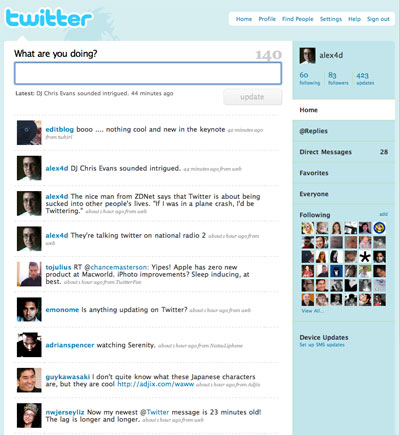
twittersigned

On the other hand, have a quick look at the post before this one…

Don’t bother with Twitter if you talk with friends and family on the phone (or by text) and you see people in person and you stay in contact with all your work colleagues without any problems and have a good career plan.

Let the pioneers make it more usable for a year – check it out at the start of 2010.

On a recent job I found myself creating a vignette shape in Photoshop because the Vignette filter in Final Cut wasn’t flexible enough for me.

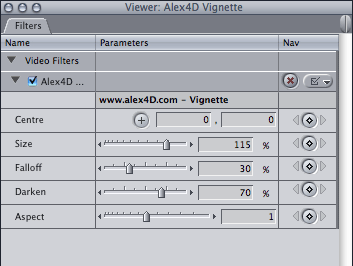
Here’s a new free plugin the gives you control over the position and aspect ratio of the vignette. That means you can direct the audience’s view and even use it for irising effects:


vignetteui

Unlike the Vignette filter that comes with Motion (and appears in Final Cut Pro), my filter doesn’t have the option to blur or desaturate the darkened area. An upside is that this should work in Final Cut Express, although I don’t have a copy to test it on.

Download Alex 4D Vignette

To use this plugin, download the ZIP document, copy the ‘Alex4D Vignette.fcfcc’ file to

Your Startup HD/Library/Application Support/Final Cut Pro System Support/Plugins

(Your Startup HD/Users/your name/Library/Application Support/Final Cut Express Support/Plugins for Final Cut Express users)

‘Alex4D Vignette’ will appear in the ‘Stylize’ filter category.

If you want a lot more control over your vignetting, visit Natress and check out their G Vignette plugin – it’s part of a large plugin set that costs less than £75.

Visit my Final Cut home for more plugins and tips
finalcuthomethumbnail

As I’ve been using Adobe After Effects over 10 years or so, it’s difficult to move over to Apple Motion, even though I haven’t upgraded my copy of AE past 6.5.

One of the things to watch out for in Motion is that you cannot change the frame rate of your project once you create it. A current project required an animation that works at 25 and 29.97 frames per second. You can always change the frame rate in After Effects, but I wanted to use the particle presets in Motion.

The way to generate animations at both frame rates is to set the frame rate to a multiple of 25 and 30 – 150fps:
motion150fps

Motion always tries to play projects at their full frame rate, but degrades well, so you’ll see your animation play smoothly as fast as your computer can play it.

There seems to be a bug in QuickTime export from Motion 3.0.2, even if you choose to export at 25 or 30 or 29.97 frames per second, it will still export at the full frame rate of the project. You need to Export using Compressor to get your outputs at PAL/NTSC or p25/p30.

A few months ago I provided some constructive criticism to an initial edit of a video shot by the talented Mr. Philip Bloom on Vimeo. Another user immediately told me that Vimeo comments should only be supportive and positive, unless the owner requested other kinds of feedback.

There’s a debate about this on one of their forums: “Totalitarian Positivity versus Constructive Criticism.”

Lucky for me, Eugenia Loli-Queru cared enough to point out some problems with one of the video doodles I posted yesterday:

Very nice idea, very nice shots, but poor execution I am afraid. The editing part needed more… editing. This is a piece that doesn’t need to be more than 2:00 to 2′:20″, and it needs the wobbly shots, or less-than-good shots, removed. Also, the music is not a great fit either.

Please re-edit this footage because you have a great idea there, and great footage in your disposal. I’d suggest you go a bit more artsy on it, check some of Charlie McCarthy pieces on similar looks for ideas on the way he edits and cuts his clips together.

That’s more useful to me than just leaving me the first two clauses and not giving me useful feedback. I should have followed my gut and not posted the video. Oh well.

Vimeo could be defined as a social media platform where a community can share high quality video. Now that competitors have better quality encodes, less limits on uploads and are less expensive, all that’s left is the community of people who share their videos. HD video is the Web 2.0 media that Vimeo shares.

Maybe support amongst creative people and people who are good at understanding the meaning of videos is what Vimeo should spend more time on – that’s more of a Web 3.0 definition. Luckily the support many Vimeo users offer each other is designed into the system. I’d probably trust the opinion of someone who’d decided to follow other people’s videos (‘Contacts’ in Vimeo parlance), ‘Liked’ many videos, set up communities of people interested in specific films (‘Channels’ and ‘Groups’), posted many of their own and provided useful feedback to others. Most of this information is visible on each user’s profile page:
vimeo-profile

My stats are OK:
vimeo-stats-a

Looks like I post enough videos to know some stuff, though they may not be any good – you could watch some linked to my profile page. I’ve been quite good at showing my appreciation of other people’s work. I don’t seem to be following the work of that many other people, but have set up a couple of communities of videos based around a theme.

Here is Eugenia’s stats:
vimeo-stats-b

She hasn’t uploaded as many videos as me, but 32 is a lot, so she probably doesn’t upload any old thing. She spends more time marking other people’s videos that she likes. She also follows the uploads of a good number of people.

One of the people I have marked as a ‘Contact’ is Remyyy. His stats are different again:
vimeo-stats-c
He is prolific and spends time looking at other people’s work.

Here are two of his videos:

It was the ideas in Remyyy’s videos that made me want to hang out at Vimeo. Before that I considered it a place to host my videos without needing to upload them to my own website.

Maybe other people would have a different measure for Vimeo authority, but at least the stats are there on each person’s profile page. We can all roll our own…

PS: If I only had the time to fix that video!

As Vimeo kindly gave me ‘Plus’ membership, you can now watch these videos in HD right here (if you click the full-screen control), until I run out of HD plays. After that, you’ll still be watch them in HD at http://www.vimeo.com/alex4d

This is a little long, in widescreen so that the limited bandwidth is used to encode more pixels. Resisted using time lapse this time.

Below Waterloo bridge, you can buy second-hand books. Music by Aphex Twin.

SD – I was playing around will stock footage back in 2001 while working on a job for Sun and I had to have a go at making one of these.

As more corporations and organisations are advised to appear on Twitter – alongside a larger proportion of internet users, some new features could be useful.

For now Twitter ‘fame’ or ‘authority’ is defined by the number of followers a user has. Fashion and changing uses of Twitter may change this measure. It may be that Twitter may suffer more than most social media platforms from the computer model of a person’s actual interest in others not being updated to reflect reality.

As Benjamin Ellis said at Media Camp London 2 in December, humans usually let relationships gradually fade away when neither party gets enough from keeping them going. In Facebook and Twitter, you need to take a specific action to stop a relationship with a friend or someone your following. People don’t like having to face up to ending these links on purpose. This means that people have real- and ex-friends on Facebook and people that Twitter thinks you’re still interested in whose tweets you no longer read.

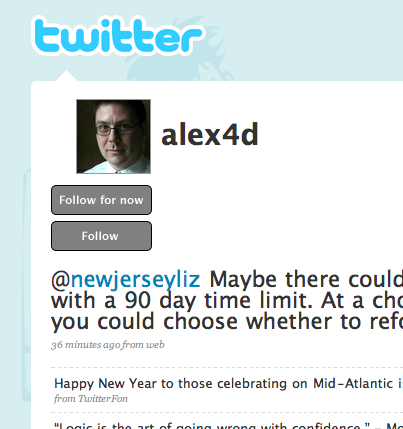
followfornow

Although most people would rather think that they have many Facebook friends and Twitter followers, social media platforms like these work better when they reflect the real relationships and interests of their members. That is why it might be a good idea to have a ‘Follow for now‘ option in Twitter. If it were for a sufficiently long time those receiving these ‘second-class’ follows would still get a compliment that is better than not being followed. 120 days might work well. At 90 days you could be reminded that the Follow for now option will run out, providing the option to stop following, repeat the ‘follow for now’ or ‘follow from now on.’

On the Twitter site and in management applications, once the 90-day point is reached, those tweets could start being displayed in fainter ink. This would simulate the fading away of the subscription.

This idea is predicated on the fact that we all benefit if social media platforms we use maintain an accurate representation of our social network…

When catching up with Maxine. a friend who is still in the conference business, she told me the tale of Nokia’s opportunity to impress some people at a multinational consumer products company.

She was working on a conference for the senior media buyers of this company who had gathered from all over the world to discuss the future of media. Between them these people controlled budgets of over €1.5bn. They talked about how social networks, interactive TV, internet search will shake up all they do when advertising their many brands to consumers all over the world. As media buyers they were repositioning themselves as internal consultants to the brand managers. This was seen as being especially useful in managing their relationships with their many ad agencies worldwide.

Instead of the usual teambuilding activity at the end, it was based around an element of the future media – what was called ‘user generated content’ earlier this year. The attendees were divided into groups and each team was given a new Nokia 95 to shoot and edit the kind of video that could be uploaded to YouTube.
nokia95

If Nokia knew that their phone was at the centre of this new media education project, would they be excited? This would position the N95 as ‘the’ media phone for some very influential people. There are three possibilities: 1. It would be good news for Nokia, 2. It wouldn’t matter one way or another or 3. They’d be worried that their phone wasn’t up to the task and that their product would look bad. There’s no way of knowing. In a way I hope it is 3, because knowing you’ve got a problem is half the battle.

You can guess how enjoyable the teams found the editing process. Maxine was pressed into service to limit the problems people had with the software. They found the user interface confusing at first and irritating once they understood how limited it was. Maxine says they ended up laughing at it.

Over the last couple of decades I’ve made a point of not following the mobile phone business. I only got myself a phone when I went freelance, I would have not got one otherwise. Phones were quite irritating back in 2001, but they seem to have go even worse in the intervening years. More and more features have been added, making the phones more difficult to use and less reliable. Or so it seems from the sidelines.

The first phone I got that wasn’t rubbish was an iPhone. The camera isn’t any good. You can’t (officially) record video with it. You certainly can’t edit video on it. You can’t copy and paste text or run more than one program at a time. I’m sure there are many phones with many more features than the iPhone has. The difference is that the phone isn’t a pain to use.

Features are less important than implementation. Over the last few years many companies created putative ‘iPod killer’ products. None of them beat Apple. They went for extra features at cheaper prices. That didn’t work. I hope Apple’s phone competitors got that message.

The phone industry had years to make phones that were any good. It happened to be Apple that came along to shake them all up. As well as having advanced software on millions of computers to manage the phone (iTunes), Apple also seems to have avoided the silly politics of the phone industry. Some people say that it doesn’t make economic sense for carriers to sign up with Apple, but it makes sense for Apple to get into deals with carriers that need them more then they need the carriers.

I hope that someone comes along to give Apple a bit of competition. They’ll need a tighter, simpler link with people’s technology (many people don’t like to run iTunes on their Windows PC) and a way of getting the best possible services to a large number of people without any restrictions from the carriers. I’m looking forward to it!