Archive

screenwriting

“This script needs more reversals in Act Two.”

An easy criticism to make of most scripts, but what does it mean? The word ‘reversal’ is so strong that I used to think that it meant ‘a major change of fortune.’ But when used in writing, it merely means an obstacle for the protagonist of the scene.

If the scene is about your hero wanting to smoke a cigarette, the reversals he faces are a series of increasingly difficult obstacles he faces to achieving his goal. Firstly he doesn’t have any cigarettes, then having got a cigarette his matches are wet, then having got a light from a stranger, having started to smoke he discovers that he isn’t allowed to smoke in the bar where he is sitting, going outside he bumps into the woman of his dreams who thinks he’s given up smoking…

From The Understructure of Writing for Film and Television:

The development of a scene is made up of several reverses leading to the crisis that, climactically, your protagonist must resolve.

Complications (as in ‘complications arise when…’), on the other hand, are crucial turns in the plot:

A complication is a development in the process of events that affects the overall objective of the protagonist…
…A reverse can never be good, while a complication in itself can be neutral: it is how your protagonist handles the complication that is important.

For example, there’s nothing bad about James Bond falling in love, but it adds complications to his mission, and his reaction to falling in love is what matters from that point on in the story.

Went to my second New York screenwriters Meetup. The script under discussion had the theme of ‘Being happy is more important than knowing the truth.’ An uncompromising first draft that has the heroine fool herself into not believing the truth in order to be happy. You can download the script from the home page for the group if you’re intrested.

Didn’t stay as long this time but heard some interesting ideas: a murder-mystery featuring screenwriters, a modern faith-based animated epic for adults and a Sci-Fi spectacular set in The Sun.

‘Jerusalem Idol’ will be the script under discussion at the next meeting.

It may be that you have a plot that suggests a theme, or a theme you need to find a plot for, but choosing a compelling theme is very useful when developing your screenplay.

Some people see screenplays as arguments on a given theme. All the characters take positions on the theme. Minor characters’ single lines state a position on the theme. Subplots explore unintended consequences of the theme. Major characters can debate the theme directly. Some can even present the argument in monologues. If you need a subject for minor characters to be talking about, turn to the theme.

The better themes can be argued more than one way. If everyone can agree on the point of the story, there’s not much point in debating it. In most cases you’ll be able to guess at the majority opinion, but great debating comes from being able to present the opposite point of view from what you believe yourself.

Themes can usually be presented as questions as well as statements:

Ambition leads to destruction OR Does ambition lead to destruction?

Themes can be presented as opposites

Ambition leads to destruction OR Indolence leads to destruction

In the first act the protagonist is unaware of the theme – their actions illustrate the negative aspects of disagreeing with the theme. In the second act the antagonist’s plans force the protagonist to react by acting as if they agreed with the theme without realising or agreeing with the statement of the theme. At the start of the third act the protagonist realises what lessons they have learned, come to an understanding of the theme and then make a choice to act in such a way that demonstrates the statement of the theme is correct.

If your cop movie’s theme is “Ambition leads to destruction”, the protagonist acts according to the theme throughout the story. In the first act we are introduced to a cop whose ambition leads her into many frustrations: she’s come to believe that whatever she does, the entrenched system will stop her from getting the position that she deserves in the force. We are also introduced to the antagonist: a corrupt cop who believes that no rules should stop them from getting to the top – ambition works for him.

In the second act, the antagonist’s plans come up against the protagonist. During a series of dilemmas, the protagonist has to choose to act as if ambition is the wrong choice – for example, she takes the blame for the antagonist’s corrupt action. In the second act the actions of the antagonist seem to demonstrate that “ambition leads to success.”

In the end of the second act, the protagonist sees the results of actions she has taken. They have led her to the darkest possible place, but she realises that she has been making the right choices (possibly for the wrong reasons – she discovers that what she wanted wasn’t enough, she realises what she needs). In the third act, she uses the tools and ‘anti-theme’ against the antagonist to demonstrate that she is in agreement with the theme and to illustrate the perils in disagreeing.

Here are some debates that you might find fun in debating:

Integrity is rewarded
Free will is possible
Know your place
Love survives beyond death
Forgiveness is weakness
You can never lose at a game you don’t play
Dedication leads to success
Technology solves all problems
There is not fate but what we make
Faith leads to conflict
Tradition is more important than love
Freedom is more important than responsibility
Greed is good!

Have a look at some of the ideas you’ve been coming up with recently. If you look for the debates within the stories, you might see the themes that you want to debate at this point in your life. If you write a journal, the topic that you are most unsure of is the theme you need to write about.

Even if your target market is far from your personal ‘demographic’ you’ll be most comfortable writing about something that matters to you. The important thing to do is to make your theme so universal that the debate is relevant to your audience, even if you aren’t a member of that audience. This is how women in their fifties write comedies for teenagers…

Went to MPEG this evening for Bill Pankow‘s editing masterclass.

He showed clips from the films he’s worked on over the years – including a deleted musical number from the Black Dahlia – burnt onto a DVD from his Avid this very morning.

Here are some of the things he said during and after the seminar.

If you have to choose between making a smooth cut between to a performance that isn’t so great and a jarring cut to the best performance, go for performance very time: “Performance is King… or Queen”

When you’re up for a job editing a film with a director that’s new to you, you get to close the deal by having a short interview. These last for twenty minutes or so, and revolve around the screenplay of the proposed film. As the editor, you should have read the screenplay and be able to come up with various complimentary things to say about it. Bill says that you on to a pretty sure thing by saying that the third act needs a lot of work, because the third act always needs a lot of work.

The director will want to know how forceful you’ll be about any ideas you want to contribute. Some directors what editors who will challenge their conceptions of the film, others want a pair of hands who won’t volunteer any of their own ideas. It’s up to the individual editor to work out if they can be one or the other. The main point of the meeting is to see if you’ll be able to get on with each other over a period of many months working together.

When starting a job, Bill likes to read around the subject. Sometimes the books are quite tangential to the source of the screenplay story, but he never knows what elements will bubble up from his reading and influence his ideas when making editing choices about the film.

Bill says that editors “make a large contribution to the writing of films.”

The highlights will be posted at the new section of the Manhattan Edit Workshop website known as ‘The Vault’ – a place where you can access clips of many famous editors talking tradecraft at previous masterclasses.

the-shape-of-screenplays

This is the way we’ve told stories for thousands of years.

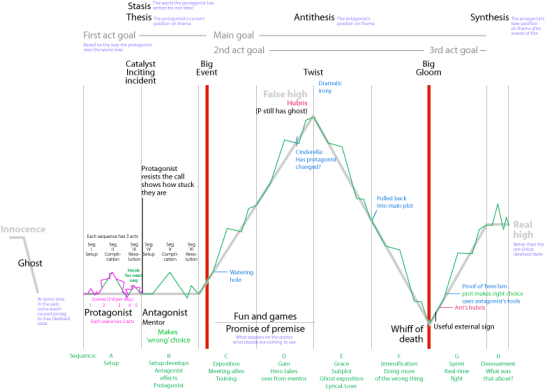
Here is a PDF based on the ideas presented by The London Script Consultancy, the people that organise the screenwriters group that I go to in London. It shows a line that represents how well the protagonist is doing. It starts with the line lower on the page. As the adventure starts, the protagonist does well – the line rises up the page. At the mid-point, the line falls down the page so that the protagonist is even worse off by the end of act 2. Luckily, due to the lessons learnt during the course of the story, the protagonist does well in act 3 and ends up in a better state than at the start.

I hope this will make a lot more sense when you download the PDF.

Another point is that each of the eight sequences  also has the same structure within it, as does each scene. This is known as a fractal structure (the same pattern at different scales), but if you don’t want to bother with chaos theory, please don’t worry about fractals.

…you might want to see this one!

Donna took me along to Paula’s place near the Lincoln Centre to see a rough cut of ‘La Americana.’

This is the docmentary to see if you want to explore the dilemma millions of people all over the world face: Choosing between being with those you love and supporting those you love.

What would you do if you had to go hundreds or thousands of miles to earn money to support your family. Some people don’t see their families for months on end. For illegal immigrants, months can stretch out into years. Imagine leaving your daughter at home and taking the huge risk of attempting to enter the USA illegally in order to earn money that can’t be found in your native Bolivia. What if you left your daughter when she was six, and she was about to turn 15. Imagine how much of her life you’ve missed out on. What if by returning home you cannot support your family any more?

That’s the story of ‘La Americana’ – by Nick Bruckman, Jesse Thomas and John Mattiuzzi.

The film looked very professional: the ‘rough sound mix’ was perfectly fine, with lots of good music; the picture quality was great; the scenes were edited very well and flowed into each other very well. All there is to do is to sort out the structure a little: to concentrate on the primary story to be told.

The reason I’ve venturing an opinion is because the team from People’s Televison, the production company, came up with a detailed questionnaire for the audience that I enjoyed filling in. Of course they basked in the compliments, but the also invited detailed feedback on sections of the film that could do with some improvement.

Most of my ideas were about structure – which came from my understanding of screenplays. I hope my feedback was useful.

A good aspect of the advanced six week course at Manhattan Edit Workshop is the practicality: our weekend homework is to come up with a good deal memo for editors. Instead of first looking on the net, I went to the local B&N. I found some interesting clauses from some interesting books. I’ll post my final version very soon.

I also looked at some other books in the film section. One of which caught my eye.

As I can control the rights to Quentin Crisp’s literary works, I was interested in book called How to adapt anything into a screenplay. The book was OK, but didn’t lend itself to helping me with my project, but there were some good outlining tips. Here are some I though were worth taking note of:

A. What single word encapsulates the theme?

B. What is your pitch sentence: “What if… And then…”

C. Answer these seven big questions

1. Who is the main character?
2. What do they think they want? What do they in fact need?
3. Who/what keeps them from getting what they want?
4. How do they succeed in an interesting/unusual/original way?
5. What are you trying to say be ending the story in this way?
6. How will you tell the story (voiceover/flashbacks/unifiying filmic devices: colour, symbols)
7. How do characters change over the course of the story?

If you can’t answer all these questions, please don’t start writing your script!

This morning was about an introduction to post-production workflow. That turned into a debate on how much to charge, how long to estimate a job could take, and the relevance of understanding the technology of post.

For a 90 minute low-budget feature where the editing starts after principal photography, the first two weeks are about getting to a first cut. The rest of the time is a debate with the director about how to make each successive cut better. Shot selection won’t change. Most performance selections will happen in the first couple of versions. The rest of the debate is about story strcuture and reordering scenes and reducing running time.

The last re-write! How many editing courses feature screenwriting structure…?

I’ve been very lucky in getting in touch with the New York film community.

My first contact is Miles Maker. He is currently based in New York, but back in 2005, he was in the UK. I edited his first short film back then. He’s done a lot more since. We met up on Sunday at the Entertainment Industry Expo. He introduced me to Jean Prytyskacz who is working on a series of specials on Hip Hop Comedians. She’s invited me to a happening at a gallery in the Inwood area of Manhattan (the latest ‘coming up’ area of New York). There I’ll be meeting more media people.

Miles took me to the soundtrack spotting session at Hughes House for his current short film production. It was inspiring hearing about the artiste’s career and current work. Amazing getting an update on Go-Go music – a genre that deserved to be a much greater movement than it was. I also had an interesting talk with Larry Robinson about new ways of marketing jazz music.

That Sunday night I did a search for “screenwriting new york” on Google. Two seconds later, the first link came up: a meetup of a group on Monday night! The small catch: the meeting was about reviewing a screenplay from a member of the group. I quickly read the first sixty pages on Sunday night, read the following 70 pages after my first day of my course (as well as the course reading homework)!

We all had a great debate about the screenplay and the method used to develop it: Blake Snyder’s 15-beat outlining method. At drinks afterwards, two people asked me to review their screenplays!

Miles and I will also be going to a panel on Thursday evening at the 5th Annual Hip-Hop Odyssey international Film Festival

…what a friendly town!

For the last few years I have been exploring screenwriting. I think that the more an editor understands screenplay structure and methods, the better the editor.

Part of understanding screenwriting is coming up with ideas for films. You can start with a character and work out an ironic situation they could find themselves in. You can come up with a ‘what-if’ high concept first, and find a character that illustrates the concept the best. Another method is to come up with a political or philosophical theme that you think an audience would like to see explored. Most good screenplays have all these elements, it’s just a question of at which point you start to come up with your idea.

Where the writer pokes their nose into the picture is when they realise what stories they feel they want to tell the the current point in their life. I’ve been looking at the film ideas I’ve been having recently and been trying to see if I can determine what stories I want to be telling right now. Knowing that will help me persue the most apposite idea.

I’ve been thinking about the dichotomy between freedom and love. You want freedom for yourself. On the other hand, you want to give up some of that freedom for those you love. The irony is that you do this so that the people you love can be free to do what they want.

I went to see Pirates 3 last night. The film was very odd: the screenwriters seemed to think that people will watch the film many times, and that it is OK for a film to only be fully understood once you have watched it more than four times. Wanting to understand their thinking about this, I found a (spoiler-filled) interview with them at Box Office Mojo . What should I find but the following quote:

…the rest of the story really is about Sartre’s [idea of] freedom—that if you enter into a relationship, you take on these obligations and limit your own freedom willingly and, if you objectify the [other] person, that can lead to sadism, whereas if you try to ensure that other person’s freedom as well as your own, that’s really the nature of love. To me, it’s such an inspiring concept.

Looks like I should have taken the time to do a little philosophy course…