Walter Murch has a rule about how much you can practically reduce the running time of a first assembly. This reduction is a little like reducing a patient’s weight. You can slim them down with diet and exercise and a lot of hard work, but there are limits.

Murch’s limit is a 30% reduction. If you have a 3 hour 20 minute film, you can reduce the running time down to 2 hours 20 minutes by trimming scenes, finessing edits: taking what you have and making it play more efficiently. If the distributor requires a running time of less than 2 hours, more drastic actions are needed. Plotlines need to be taken out, entire characters removed.

So be aware that a 120 page script may sometimes expand to a 160 minute film, but cutting the movie down to less than 115 minutes will require serious surgery. That’s why you’ll discover that your story will survive with a single kidney or lung, or even eye…

In Mark Litwak’s Risky Business book, he lists 17 items on his Filmmaker Defense List.

Here is a summary of some of the most important ways filmmakers can protect their interests:
[…]
3. Obtain an arbitration clause: make sure contractual disputes are subject to binding arbitration […] Arbitration is less costly than litigation, and going to court is not much of a remedy if you can’t afford it.

That’s a good idea, but watch out for a wrinkle. You need to make sure the arbitrator isn’t biased in favour of the distributor. A recent report into credit card companies use of binding arbitration shows that individuals should opt out of that clause in their contract with credit card companies. In the case of producers agreements with distributors, both parties should agree on the choice of arbitrator.

There’s more information on dispute arbitration on Mark’s Entertainment Law resources site.

Recently I’ve been pitching a romantic comedy, but I’ve been pitching it wrong. I’ve kept the ‘Big Event’ secret and made it a twist for those I’m pitching to. It’s good to surprise people, put there’s a flaw in that plan.

The Big Event is the development that takes the protagonist out of the world they’ve settled for. It gets the protagonist into the situation that is the premise of the film. The problem about making this a big secret in your pitch is that producers cannot market the film without selling the premise. You can’t sell The Truman Show without stating that the odd things hero is noticing are due to the fact he is the star of a real-time soap opera that he knows nothing about. You can’t sell Alien without saying that a group of people find themselves trapped in a spaceship with a creature they don’t dare kill.

So, you start your pitch with the situation at the start of act 2. Those are the scenes that will be in the trailer, summarised by reviewers, the premise that will get people into the cinema.

Why do we need to learn how to pitch? Producers can only get behind ideas they can pitch. Even if they care about the characters and the story, if they think the film has a message that many people should hear, they cannot produce films that don’t have audiences. Audiences go to films in response to marketing. When you are discussing which films to see with your friends, you pitch the premise – the Act 2 situation. Producers and distributors need to make sure that people have the information they need to pitch films to their friends.

Once you start with your premise, you can tell the story of who the protagonist is, the world that they start off in, the antagonist they face: the first act. Then you explain how all these elements are resolved: the third act. Then you ask if there are any questions. They’ll ask for more set pieces that the premise promises. I think that’s how it works.

The thing about shorts is that you can have more mystery about the big event. The surprise of the big event will be one of the more memorable moments of your short. This is partially due to lack of any marketing you are able to do for shorts. As there are so few elements you can fit into a short, you can only give away the character and setting. These should be interesting enough for people to choose your short over another at a film festival. Alien: ‘The story of a woman crewmember whose deep space ship crew is woken by a mysterious signal from a seemingly dead planet.’ The Truman Show: ‘A conventional man starts to suspect that there is something very strange about everyone in his ‘ideal’ community.’

That’s why it is a popular idea to make a short film that acts as the first act in a proposed feature.

Here’s a dilemma: after disagreeing with your client on most apects of a new version of a script and edit you’ve done, should you:

a. Finish the work efficiently and resolve to not work for that client again, or

b. Realise that being a professional means that the people that you work for do not need to know your opinion unless they ask for it, and are free to ignore it.

It’s a matter of networking and money vs. freedom to choose who you work with.

I’ve yet to make my decision.

My friend Matt invited me to check out Kaltura, a communal video editing community (Their main site doesn’t support Safari so Safari users should take a look at their blog).

Their current plan is that you join up and initiate projects that can be shared with whoever you want. You come up with the kind of video you want to make, upload some clips, and invite people to add clips or make their own edits.

The concept is that this site gives access for ‘normal people’ to the tools for them to collaborate in editing films. More than one person can upload footage, more than one person can edit.

A Kaltura on kaltura.com

Each ‘Kaltura’ is ‘a community of clips and edits’. If you are a fan of a band, you could set up a site where you and others can upload clips and make fan videos. If you want to make a campaigning video, you can add clips of footage that might help get the message across.

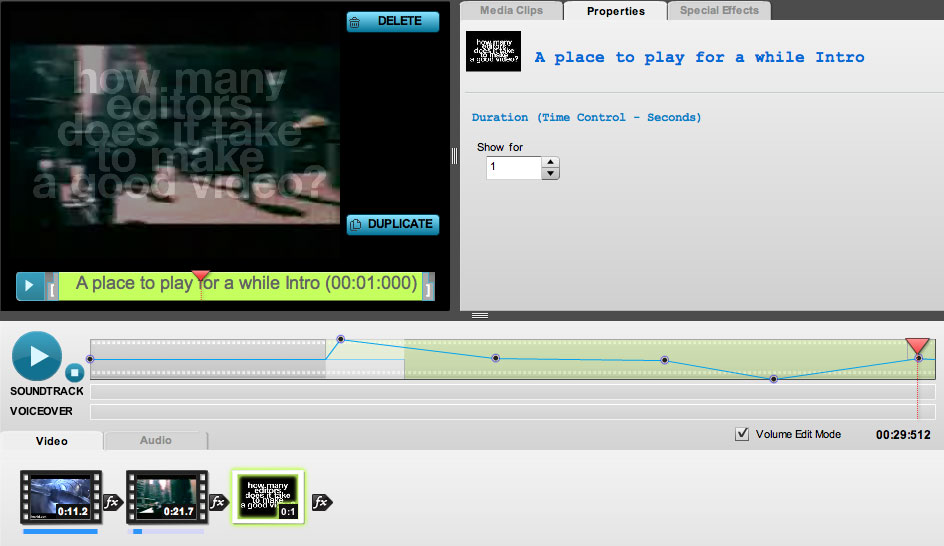
Kaltura editor

The video editor looks like an early version of iMovie. It’s flash based, so there don’t seem to be any keyboard shortcuts or mouse shortcuts.

Or an Undo feature.

All footage is assumed to be 4:3 ratio. There are a variety of transition types. You get one layer of video (with a text overlay channel) and three sound channels: from the clip on the timeline, a channel for music and effects (they need to be bounced down to a single file) and a channel for voiceover.

Do projects benfit from multiple editors? Could this be used for a team collaborating on edits? If this is offline resolution, how do I get the EDL so I can do the online?

…and when will they support Apple Safari?

The following is a summary of the lecture given at yesterday’s Soho Screenwriters meeting:

Once you have a premise, you need to make sure you understand the genre of your idea. Is it a thriller, a romantic comedy, an action, an action-adventure or is it from some other genre? Once you settle on a genre, watch ten of the best examples of that genre. A good way of understanding the mechanics of a drama is to write outlines of the films you see.

An outline is made up of describing what happens in each scene: “Ripley is attacked by Ash for no reason, Parker appears, goes to her aid – he lands a killing blow, but they discover that Ash is a robot.” “In the school canteen, Marty attempts to convince George to ask Lorraine to the dance; he discovers that George writes sci-fi short stories, he says that George should try to find a publisher.”

This sort of outline is a synopsis only of what happens on screen. You can use this to examine the mechanics of your genre. You’ll see that in horror films for example, the leader of the group is often killed in the middle of act two.

For the main outline of your film, you need two objective outlines. These objective outlines show the actions and goals of your protagonist and antagonist.

For many genres, you need to build the antagonist’s objective outline first. What is their plan? How do they deal with the incursion of the protagonist? In Back to the Future, Biff plans to take Lorraine to the Enchantment Under the Sea dance. His plans are spoiled by Lorraine falling in love with the mysterious Calvin Klein, the new kid who shows him and his gang up in front of the whole town. How does he deal with this change?

Having the antagonist’s plan designed, you need to come up with the protagonist’s objective outline. His objectives change as he goes through the story: Marty wants to take his girlfriend up to the lake, but Biff has totalled the car he planned to use. Later he needs to find Doc Brown so that he can find a way back to the future. Once they have a plan ready, they discover that his mother Lorraine has fallen in love with him, that means his parents won’t kiss at the dance, he needs to get his parents together.

The third outline you write is the one that maps the hero’s arc. This is the protagonist’s subjective outline: the one that describes the psychological development of the protagonist. This outline starts with scenes that show that the protagonist has come to an incorrect view on how to live their life. They have settled for something less than a full life due to some event that happened before the start of the film. This is how the theme is introduced. You describe the elements that describe the psychological state of your protagonist. As films cannot stay inside people’s heads, you need to add elements to your scenes that don’t directly further the objectives of your protagonist. In Back to the Future, the school principal says “No McFly ever amounted to anything.” After failing the Battle of the Bands audition, he tells his girlfriend that he won’t succeed, so why try? He’s settled for a life where he doesn’t risk anything for fear of failure: He won’t send off his demo tape to record companies in case they don’t like it.

The subjective elements of act one introduce the theme (“He who dares, wins”) by illustrating a less than full life of someone who hasn’t learned the theme lesson. In act two, the obstacles preventing the protagonist from achieving their objective goals are the ones that test the internal flaw (“I’m scared of failure”). In the first part of act two, the protagonist meets characters that embody the lesson of the theme (Goldie the janitor has the confidence to attempt to be the first black mayor of Hill Valley, Doc Smith of 1955 is galvanised by the thought that one day he will invent something that works). During act two the protagonist will start acting as if they understood the lesson of the theme without realising it. They might even advise someone else to follow the theme lesson (Marty tells George to send his stories to a publisher, he also attempts to scare him into asking Lorraine to the dance).

The subjective outline finishes at the beginning of act 3: the experiences of act 2 have forced the protagonist to learn their lesson. In act 3 they act based on the lesson of the theme (Marty goes up on stage to help the band so that his future parents will stay dancing and then kiss – he does this even though he might fail. After his parents kiss he goes too far with his music. The audience doesn’t get it, but Marty doesn’t mind this little ‘failure’ – he laughs it off with a joke).

These three outlines delineate the core of your film idea. Most screenplays don’t have a satisfactory protagonist objective outline. Those that do don’t have a good antagonist objective outline – they aren’t strong enough (‘the antagonist is the hero’s mental illness’) or their plan makes no sense. Even if you have two good objective outlines, your film won’t be satisfying if you don’t have a worthwhile subjective outline for your protagonist. What life have they settled for, what flaw do they have, what is the worst possible thing that could push them out of their life? What would be the hardest thing for them to do?

Looking for these outlines is a good way of analysing treatments and screenplays.

The fourth outline? That’s for protagonist of the main subplot…

When asked which elements sell projects to him, Ron Howard answered:

1. Theme
2. The dilemma of the protagonist
3. The context of the story

No mention of plot in his top three. He used to bear in mind which audiences might like a film. He says that he’s less worried about that now.

Have a listen to his 110 minute podcast on the USC website. He talks a lot about collaboration with agents and studio executives as well as with writers and crew members. He also answers questions on how he works with actors, cinematographers, editors and composers. Check it out!

It’s a good idea for writers and editors to put themselves in the place of producers. Sadly that means understanding many of the issues you can find at the Entertainment Law Resources website.

Legal issues come up almost every day for producers. The more we all understand about the needs of distributors, studios and those who invest in films, the clearer our positions will be. For example there’s an interesting article on the legal issues behind raising money using product placement in films and TV.

There’s also an article on a simple way for writers to protect their interests when pitching a movie idea to producers.

After having a look at the new user interface for Microsoft Office, I was wondering how I would update the icon on the ‘Save’ button.

Word 2008 - top left corner of document window

Apple launched their first Mac that didn’t have a floppy disc drive nine years ago. I wonder if the people who have come to use computers since then recognise what this ‘Save’ icon represents.

Even if you do recognise it, why does a picture of a floppy disc represent the ‘Save’ action? This picture should mean ‘Show me what is on my floppy disc.’ ‘Save’ is short for ‘Commit the current version of the document to a place where I can recover it from should I need to.’

We need a new representation of the places that we keep our information. In a few years time we won’t care about the physical location – those details will be someone else’s job to look after. I suppose an illustration of memory or time would do for that. We need a good writer to come up with a concept that can be illustrated with a few pixels on a toolbar button.

Yesterday, I went to my first meeting of the Non-Multplex Cinema group in London. They started as a group of people who meet up, go and see a non-mainstream film and chat about it afterwards in a pub. Then they branched out into short film production. Now that their short is in post, they’re turning to sharing knowledge and networking.

Yesterday was about GLOMEX – The Global Movie Exchange. Steve Tyler came to explain what they’ll be offering.

One of the problems with film financing is the complexity of the funding deals that producers need to put together. There can be too many sources involved. They have differing priorities and expectations. Projects often fail when a small piece of the funding is pulled.

GLOMEX is a trading market where producers are put in touch with investors. Producers create a company whose total share value is equal the budget they want to raise to make their film. The shares in this company are offered on GLOMEX. Once the shares are fully subscribed, 100% of the budget has been raised. The bank associated then hands over the money to the producer as per the schedule promoted in the offering.

The producer pays $10,000 to the market for GLOMEX to do the financial diligence on the project. They make sure that the people involved have complied with the financial requirements of setting up the production – and they are likely to continue to keep investors informed on financial matters. Those providing the market do not assess the quality of the script, the artistic or technical abilities of the film makers. It is up to the producer to put the package together in such a way that investors are interested.

After the film’s budget is fully funded by the IPO, the shares can be traded on ther GLOMEX secondary market. Shares can be bought and sold, with the share price determining the total value of all shares in the film. Unless the film makers buy shares of their own, they don’t benefit for any rises in the value of the shares. This secondary market makes investors interested in making money from film finance. If they make money buying shares in films in this market, they’ll be around to

Initially, GLOMEX only want to deal with funding 100% of the production budget. This is a problem for producers whose skills lie in tapping into many different funding sources. This rule is to make it clear that each share gets an equal part of any film proceeds. This wouldn’t be possible if there was some funding coming from government bodies or other sources.

GLOMEX say they want to ‘Securitise an un-secured market.’ They think that many amateurs will want to take the chance to invest in the film business.

This was sold as being for audiovisual productions of all sizes: shorts, animations, radio, games and mainstream movies. The people who’ll make money for the market will be the advisors that producers will need to hire to prepare their IPO and the auditors who’ll need to keep the market informed on outgoings and income to the production.

Writing as someone who is in on the last rewrite (when the film is edited), the oddest condition for listing a production on GLOMEX is that the script needs to be final! I assume that it’ll be the producer’s responsibility to inform the shareholders about any significant changes that move the production away from the script included in the investor presentation.