This tip gives you control over the default titles you can add to your projects using new menu commands in Final Cut Pro 10.0.3. It requires you to go deep inside your copy of FCP and make a simple change. If you have Motion, you can modify a title template you use often and make that new template your default title.

Although the new version of Final Cut Pro X advertises features designed to attract and placate ‘professionals,’ Apple have also been paying attention to the problems new users have in getting straightforward tasks done.

There are now two simple Title templates: ‘Basic Title’ and ‘Basic Lower Third’ – these act more like the text tools in other editing applications – you use them to overlay text onto video. Unlike the rest of the Titles in Final Cut, they don’t animate on or off the screen. They don’t have any associated graphics either. Although they are ‘basic’ in that respect, you can use multiple fonts, colours, sizes and effects in the text. You can also reposition them simply by dragging the anchor point.

You can add these two titles to your timeline using two new menu commands:

Read More

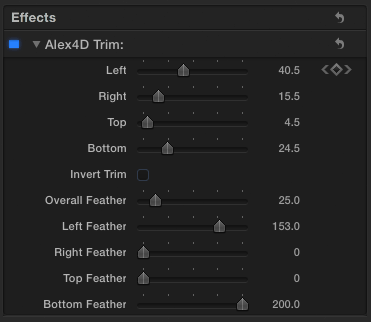
These six Final Cut Pro X effects give you more control over the way transform and trim effects work.

You can choose how values change between keyframes – effect the shape of the value curves for x position, y position, rotation, scale and edge trim amount:

In the scale and rotation effects you can also set the centre point around which the clip is scaled and rotated:

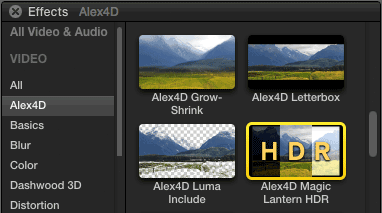
Magic Lantern is a system for adding features to Canon DSLRs, Unified is a recent ML package enables some cameras to shoot footage that can processed to produce content with a larger exposure range – i.e. High Dynamic Range.

The files produced are made up of alternate frames of under- and over-exposed footage. My new generators take these frames and give you the control to define how the overexposed frames are overlayed on top of the underexposed frames.

For more information on Unified and Magic Lantern and the software to for your Canon DSLR, visit the Wiki

December 2012:  I’ve replaced the generators that were here with a single effect.

in-titles-browser

Go to my newer blog post on the new version.


Last week, Bret Victor posted A Brief Rant on the Future of Interaction Design, a must-read essay for those who think that the future of technology interaction will be primarily spent stroking flat panes of glass:

[T]ake out your favorite Magical And Revolutionary Technology Device. Use it for a bit.

What did you feel? Did it feel glassy? Did it have no connection whatsoever with the task you were performing?

I call this technology Pictures Under Glass. Pictures Under Glass sacrifice all the tactile richness of working with our hands, offering instead a hokey visual facade.

[…]

With an entire body at your command, do you seriously think the Future Of Interaction should be a single finger?

Perhaps he is right. Minority Report‘s computer interactions have been very distracting for many OS user interface designers.

Read More

This transition first shows a few frames of the incoming clip, then some of the outgoing clip, then the incoming clip and continues in varying patterns.

It re-creates the ‘cuts only’ scene transitions used in the early 70s in films such as ‘Easy Rider.’ By showing a few frames of the next scene a little while before it starts, the clip acts as a ‘premonition’ of what will happen next. It was also used with a musical cue in ‘Captain Scarlet’ – a kids TV series.

As well as using the incoming clip, there is also the option to use a frame from elsewhere in your primary storyline instead. You choose it by dragging a ‘Timeline Pin’ which appears when you select the transition:

Here are the controls:

Read More

Final Cut Pro version 10.0.1 includes an updated version of the Ticker title effect. I’ve come up with some additional improvements. The most useful one is that I’ve linked the size of the background of the ticker to the font size of the text (note that the font size control in the Text tab of the inspector is disabled – use the text size control in the Title tab instead).

Read More

This is a quick post listing a few of the internal differences between version 10.0 and 10.0.1 of Final Cut Pro X.

Updates in Final Cut Pro / Contents /Resources / en.lproj / PELocalizable.strings

A few extra messages associated with importing XML.

There are also some messages supporting those attempting to run 10.0.1 on systems with unsupported graphics cards:

    To ensure optimal performance, use a graphics card that meets minimum system requirements. For more information on minimum system requirements, visit the Tech Specs page on the Final Cut Pro website.
    This system does not meet the minimum system requirements for graphics cards. For more information on minimum system requirements, visit the Tech Specs page on the Final Cut Pro website.
    This graphics configuration does not support hardware acceleration, which is required to run Final Cut Pro X.
    Safe mode does not support OpenGL hardware acceleration, which is required to run Final Cut Pro X. Please reboot normally and try again.

There is also support for running in trial mode.

New UI elements added to the Final Cut Pro/ Contents / Frameworks / Flexo.framework / Versions / A / Resources / en.lproj / directory:

    FFAXELExport.nib
    FFAXELImport.nib

    FFAudioMatchWindow.nib

    FFColorBoardContentView.nib
    FFColorMatchWindow.nib

    FFDataListClipsView.nib
    FFDataListRoleSetTile.nib
    FFDataListRolesView.nib
    FFDataListRoleTile.nib
    FFDataListTagsView.nib

    FFMatchAccessory.nib
    FFMatchFooter.nib

So there is more internal support for AXEL – ‘Apple eXchange Editing Language’ flavour of XML (which is distinct from Final Cut Pro XML v1.0). Here are two consecutive lines of Final Cut Pro / Contents / Frameworks / Flexo.framework / Versions / A / Resources / en.lproj / FFLocalizable.strings:

    “FFXMLFORMAT” = “Final Cut Pro X XML, %@”;
    “FFAXELFORMAT” = “Apple eXchange Editing Language (axel), %@”;

In the same file there is some additional text to support roles, including a concept I haven’t heard of yet:

    “FFSetRole” = “Set Role”;
    “FFFocusRole” = “Focus Role”;
    “FFUnfocusRole” = “Unfocus Role”;

I wonder what ‘focus’ing a role means…

If you have Motion 4, you might miss all the project presets you are used to.

The internal format of these presets is the same for Motion 5. That means you can copy the presets you’d like to use from inside Motion 4 to Motion 5.

To see the wide variety of project templates in Motion 4, view its contents (by right- or control-clicking the Motion 4 app and choosing ‘Show Package Contents’ from the context menu), and navigate to

Motion 4.app / Contents / Resources / English.lproj / Presets / Project

If you’d like some of these presets in Motion 5, use the following method.

Read More